
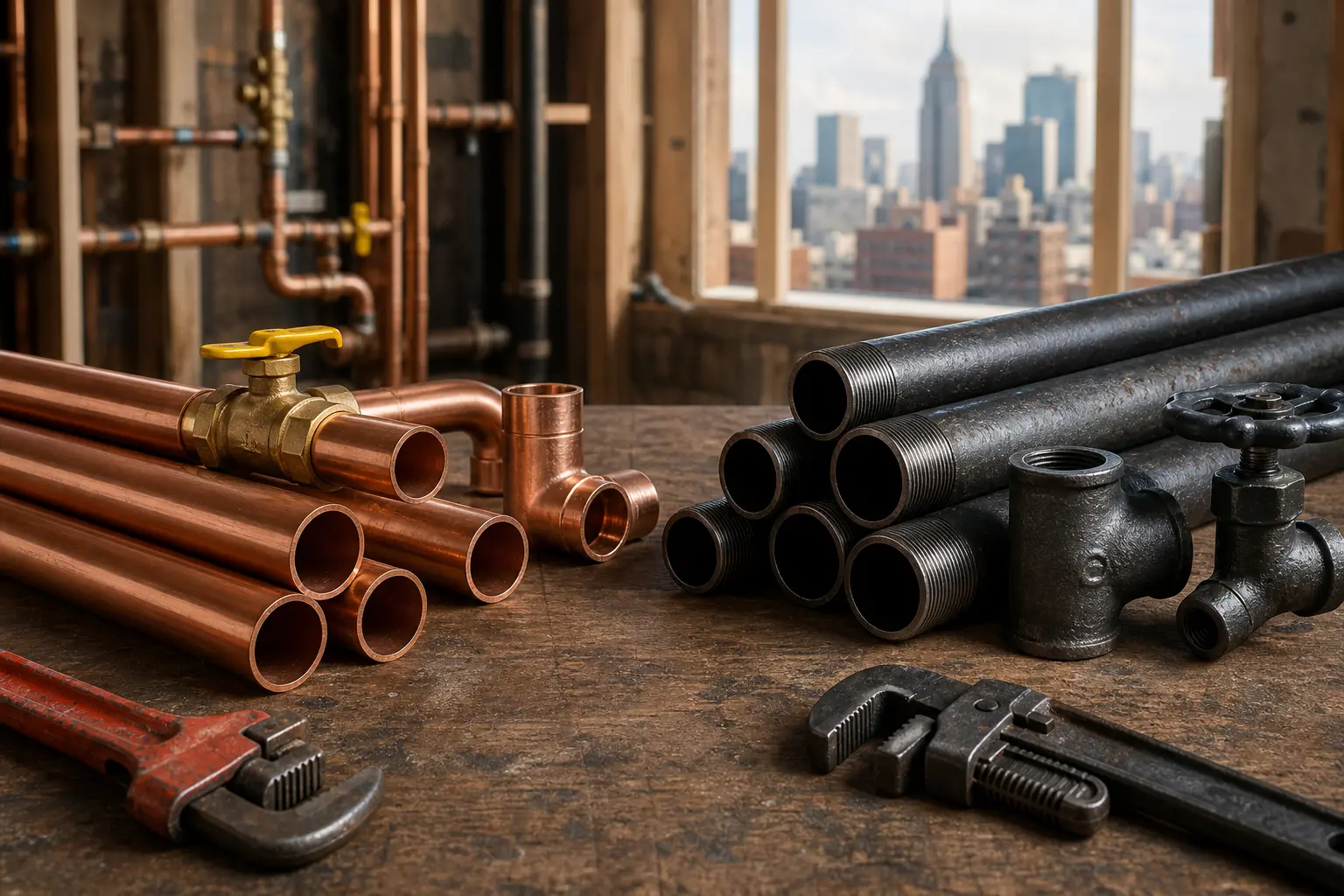
A plain-English comparison of copper and black iron gas pipe, so NYC property owners can tell a legitimate code requirement from an upsell before signing off on a job.
Here's the short version: both copper and black iron gas pipe are legal in New York City, but the Department of Buildings and most gas utilities only approve each one for specific uses. If a plumber tells a property owner their copper line has to come out and be replaced with black iron, that might be a straight code issue, or it might be someone padding a quote. The only way to know which is to understand what each material is actually rated for in your specific situation.
This matters more than most owners realize until they're staring at a failed inspection notice or a change order mid-renovation. The material a plumber runs isn't a style choice like a faucet finish. It affects whether the job passes inspection the first time, whether an insurance adjuster has questions after a leak, and whether a buyer's attorney flags something during a pre-sale inspection of a brownstone or co-op unit.
What Black Iron and Copper Pipe Are Actually Used For
Black iron is what's running through most NYC buildings put up before the 1980s or so, and it's still a common pick for new gas distribution lines, particularly in multi-unit residential buildings and commercial spaces. Whether it's required or simply preferred depends on the specific project, the utility serving the building, and what the Department of Buildings signs off on for that address. It's the pipe a plumber often reaches for when running gas to a boiler, a commercial range, or a rooftop unit. If your building has original gas piping that nobody's touched since a renovation, there's a good chance it's black iron.
Copper shows up differently. It's often added later, during a kitchen remodel, a new appliance hookup, or when a line needs to be extended to a spot the original black iron never reached. Gas-rated copper isn't the same copper used for your water supply lines, which is a mix-up that trips up a lot of property owners. The copper approved for gas use has to meet specific thickness and coating standards, and suppliers often mark or wrap it differently than standard plumbing copper, though labeling isn't something a property owner should rely on to confirm code compliance themselves. If someone installed plain water-type copper on a gas line, that's not a material choice, that's a code violation waiting to get flagged.
Older NYC buildings frequently end up with both materials in the same system; a black iron trunk line with copper additions from a past renovation, or vice versa. That's not automatically a problem, but it's exactly the kind of thing an inspector looks at twice, and it's worth having someone familiar with gas line installation in Manhattan buildings take a look before assuming an old patch job is still sound.
Cost, Durability, and Corrosion: Where Each Material Actually Differs
Copper costs more per foot, that part's not in question. What surprises a lot of property owners is how much that gap moves depending on the metals market in a given year. Copper pricing swings. Sometimes it's close enough to black iron that the decision barely matters on cost alone, other times it's a noticeably bigger line item on the invoice. Anyone pricing out a job months in advance should treat quoted copper costs as a snapshot, not a fixed number.
Corrosion is where the real difference shows up, and it's not a simple "copper wins" story. Copper resists the kind of surface rust that eats through black iron, but it's got its own weak spot: contact with certain soils or dissimilar metals can cause pitting over time, which is part of why it's typically not approved for underground gas runs in NYC. Black iron holds up fine outdoors and underground, but indoors, especially in older systems, moisture and sulfur compounds in the gas supply can corrode it from the inside out. A 60-year-old black iron line that's never been inspected is a reasonable thing to be a little suspicious of.
Labor is the piece people forget to weigh. Copper bends and runs through tight joist bays and tricky wall cavities with far fewer fittings. Black iron has to be threaded and connected with fittings at every turn, which adds labor hours on jobs with a lot of direction changes.
Think about a multi-unit landlord mid-renovation on a bathroom, deciding between patching a short run of black iron or rerouting the whole thing in copper to clear a new wall layout. The black iron patch is cheaper today. The copper reroute costs more upfront but sidesteps a tight, hard-to-access joint that would've been a pain to service again in ten years. For a commercial property or a multi-unit building, that kind of maintenance frequency can matter more than the invoice total on day one. Anyone unsure which trade-off fits their building should talk it through with a licensed plumber before the walls close back up — the gas line installation and repair team can walk through both options against the specific layout and usage.
NYC Code Requirements That Decide the Material for You
Here's the part a lot of property owners miss: this usually isn't a judgment call. NYC's gas code, the Department of Buildings, and the utility companies (Con Edison and National Grid, depending on the borough) all have their own rules about where copper gas pipe is allowed and where it isn't. Depending on the system's gas pressure and the building's classification, copper may not be an approved option at all, and black iron ends up being the only choice on the table. A building's gas pressure, its age, and even which utility serves it can all push the answer toward one material before anyone's personal preference enters the picture.
This is also where jobs go sideways. An inspector doesn't care that copper looked fine to the last plumber who touched the line. If the material or the fitting type doesn't match what's approved for that specific application, the inspection fails, a violation gets issued, and now there's rework plus a delay on top of the original cost.
- Gas pressure rating for the line in question (low-pressure vs. higher-pressure systems)
- Building classification — residential, mixed-use, or commercial
- Which utility company serves the property and their specific material approvals
- Whether the application is interior distribution piping or a meter-to-appliance connection
- Fitting and joining method used, since some are approved for one material but not the other
There's also the ongoing inspection side of this, separate from new installation. Local Law 152 requires periodic gas piping inspections on a recurring cycle, and that requirement applies no matter what material is already in the walls. Copper doesn't get a pass, and neither does black iron. If a property hasn't had its gas piping inspected on the required cycle, that's a compliance gap worth closing regardless of what the pipe is made of.
Code gets updated, and requirements can vary by borough and building class, so this isn't something to settle based on an old renovation or what a neighbor's building used. A licensed plumber should confirm current requirements for the specific address before material gets chosen. For buildings carrying open violations tied to piping material or inspection history, it's worth having a gas violations specialist review the file before any new work gets scheduled.
A Simple Way to Decide Between Copper and Black Iron for Your Project
Once the code question is settled, the material choice usually comes down to a handful of practical questions. Before calling anyone out, it helps to think through where your property stands on each of these:
- How old is the building, and what's already running through the walls?
- Is this a brand-new install, a repair on an existing section, or a reroute during a larger renovation?
- Are you planning to hold the building long-term, or is this a shorter hold where upfront cost matters more than longevity?
- Does the project fall in a zone or application where the utility or DOB restricts one material outright?
- Is any part of the existing system copper, black iron, or something older that needs to come out anyway?
For a straight repair on an existing line, matching the current material is usually the move. Patching a black iron system with a copper section just creates a transition point that has to be done exactly right, with the correct fittings and dielectric unions, or it becomes a corrosion risk down the road. A past repair that ties new pipe into old pipe with the wrong connector can sit there quietly degrading for years before anyone notices it, which is one reason a second opinion on an older patch job is worth the cost.
Renovations are a different story. Gutting a kitchen for a new gas range, opening a wall for a boiler swap, or repiping a unit after a violation gets fixed are all reasonable moments to upgrade material if the code and budget support it. A licensed plumber doing a proper walkthrough, like the kind offered through a master plumber serving Manhattan properties, should be the one making that call for your building, not a preference formed from a weekend of online research.
Signs Your Gas Line Needs Attention Regardless of Material
None of the copper-versus-black-iron discussion matters much if the line in front of you is already failing. Material choice is a planning question for a new install or a repipe. A suspected leak is a different situation entirely, and it gets the same response no matter what the pipe is made of.
A few things should stop the research and trigger a call to a licensed plumber the same day:
- Any smell of gas, even faint or occasional, near appliances, meters, or basement piping
- Visible rust, pitting, or green-ish corrosion on fittings and joints
- A pressure test that fails or drops faster than it should during an inspection
- Old gas work with no visible permit sticker or paperwork on file with the building
- Scorch marks, soot, or a pilot light that keeps going out for no clear reason
Any one of those is reason enough to get someone qualified in to look, not research the pros and cons of pipe materials first.
Commercial properties carry more weight here than a single-family house does. A landlord with six units or a restaurant owner with a gas range running during dinner service isn't just managing a repair, they're managing tenant safety and liability exposure while a forced shutdown plays out. A residential homeowner can usually absorb a day without hot water. A commercial kitchen losing gas service for a week is a different kind of problem, and insurance carriers tend to ask pointed questions after the fact about what was known and when.
Old black iron pipe that's dry, intact, and passing inspection doesn't need to be replaced just because it's old. But a property owner noticing any of the signs above, regardless of whether the line in question is copper or black iron, is past the point where the material comparison matters.
Getting the Right Material Installed by the Right Team
Picking copper or black iron correctly doesn't count for much if the person installing it threads a joint wrong or skips a pressure test. Material choice, code compliance, and workmanship are tied together. A property owner can do all the research above, land on the right pipe for their building, and still end up with a liability if the install itself is sloppy.
Before signing off on any gas work, it's worth asking a few direct questions. Not every contractor who shows up with a van and a quote is set up to handle NYC gas work correctly.
- Are you a licensed master plumber, and can you show proof of that license for this specific job?
- How familiar are you with current DOB gas code and the utility's (Con Edison or National Grid) requirements for this neighborhood?
- Will you pull the permit, or is that on me?
- What's covered under warranty if a joint fails or an inspection flags something six months from now?
Answers that are vague, or a contractor who seems annoyed by the questions, tell you something too.
The fastest way to settle copper-versus-black-iron for a specific building is to get a licensed plumber to look at the actual pipe, the actual appliance load, and the actual building age in person. Schedule a gas line assessment and walk away with a material decision backed by a permit and a warranty, not a guess.
Frequently asked questions
What's the best pipe to use for a gas line?
There's no single answer, because NYC's gas code and the utility serving your building (Con Edison or National Grid) decide what's approved for your specific setup. Black iron is the default for most indoor distribution and the only option when copper isn't rated for the pressure or application. Copper works for shorter runs added during a renovation, but only gas-rated copper, not standard plumbing copper.
Can you use black iron pipe for gas lines?
Yes, and in most NYC buildings it's the standard. Black iron handles outdoor and underground runs fine and is what you'll find in buildings put up before the 1980s. It's threaded and fitted at every turn, which adds labor on jobs with a lot of direction changes, but it remains the go-to for boilers, commercial ranges, and rooftop units.
Is it a good idea to use copper pipes for natural gas lines?
Sometimes, but not always, and not with just any copper. Gas-rated copper has to meet specific thickness and coating standards, different from the copper used on your water lines. It resists surface rust well and runs easily through tight joist bays, but it's not approved for underground gas runs in NYC and isn't always permitted depending on the building's gas pressure and classification.
What are the disadvantages of using black iron pipe?
Indoors, especially in older systems, moisture and sulfur compounds in the gas supply can corrode black iron from the inside out, which is hard to spot without an inspection. It also needs threading and fittings at every joint, so jobs with lots of turns rack up more labor hours than a copper reroute would. A 60-year-old line nobody's inspected is worth a second look.
How do I know if my plumber's material swap is a code requirement or an upsell?
Ask what specifically makes the current material non-compliant: the gas pressure, the building classification, or the utility's rules for your address. A legitimate code issue has a specific citation behind it, not just a preference. If your plumber can't point to why your exact line fails, get a second opinion from someone familiar with gas line work in NYC buildings before signing off on the change order.