
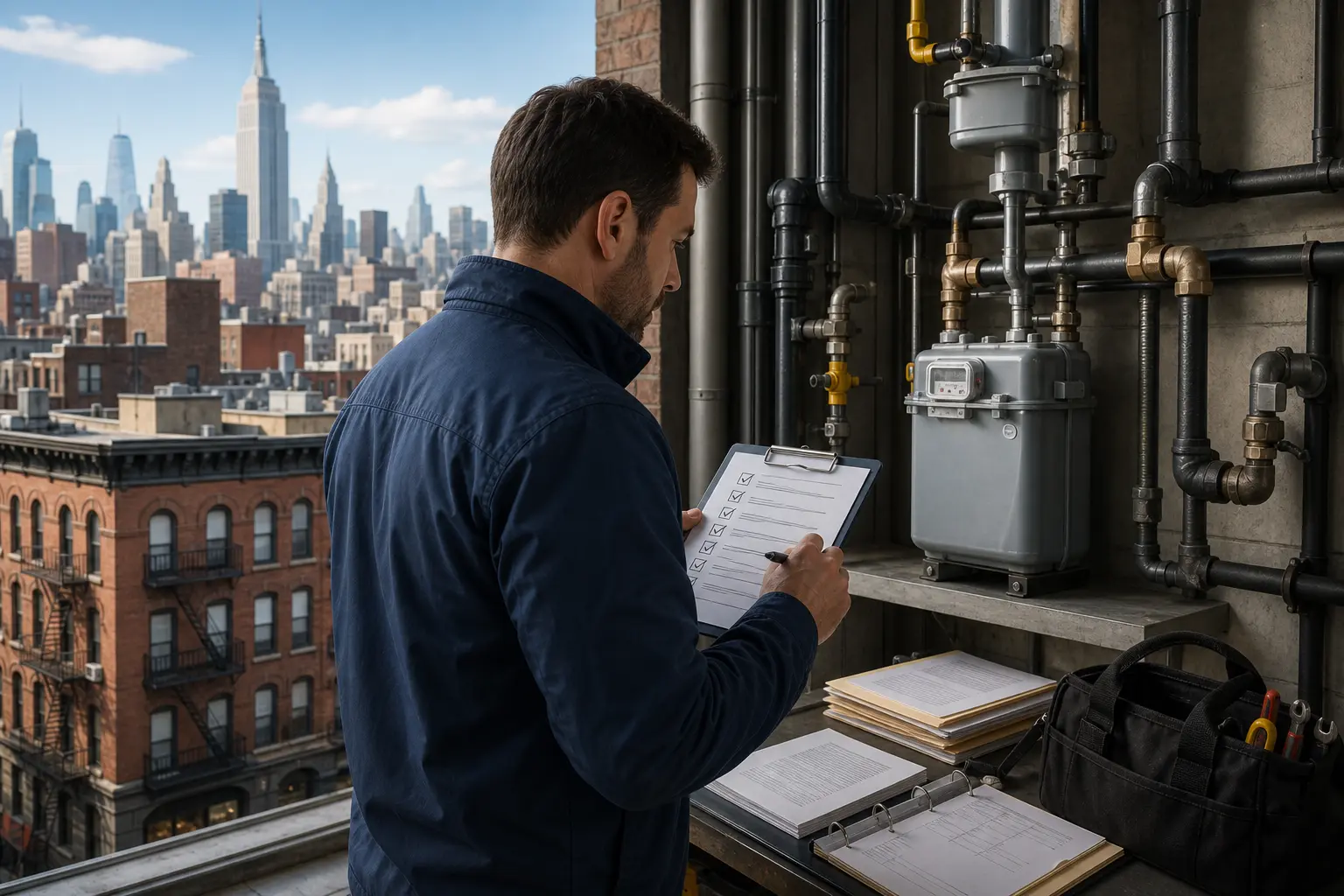
A practical rundown of what NYC owners and managers need to pull together before a Local Law 152 gas piping inspection, so nothing stalls on inspection day.
The notice usually shows up in the mail or the DOB portal with a window of a few weeks, and most owners' first move is to hand it to the super and assume it's handled. It isn't, at least not entirely. A super can unlock doors and point out which apartments have been renovated, but the inspection itself is looking at gas piping condition, corrosion, unauthorized connections, and whether work done since the last cycle was actually permitted. None of that gets fixed by someone without a plumbing license.
Skipping prep doesn't just risk a failed inspection. It can turn into a correction window measured in weeks, a reinspection fee, and in some cases a DOB violation sitting on the property's record while tenants ask why there's no gas to the stove. A local law 152 plumber can walk the building beforehand and flag the stuff an inspector will flag, which is the whole point of doing this early instead of finding out the hard way.
What Triggers Your Building's Inspection Window
Local Law 152 doesn't work off one citywide deadline the way some other compliance laws do. There's no single date every owner circles on the calendar. Instead, the Department of Buildings splits the five boroughs into community districts and assigns each one a filing window on a rolling cycle that repeats on a multi-year basis. Your building's deadline depends on which district it sits in, not on when you last had plumbing work done or when a neighboring building got inspected.
This trips people up constantly. Owners hear about energy benchmarking laws or facade inspection cycles and assume gas piping inspections run on a similar track. They don't. Different law, different trigger, different agency scrutiny. Mixing them up is how a building ends up missing its actual window while someone's busy prepping for the wrong deadline entirely.
Another common mix-up: a Con Edison gas line check or a repair call after a smell of gas does not count as your Local Law 152 inspection. Those are separate events, handled by separate parties, for separate reasons. Only a licensed master plumber's inspection, filed properly with the DOB, satisfies the law.
A few things worth confirming early, since they determine whether a building is even on the hook this cycle:
- Which community district the property falls under, found through the DOB's building information search
- Whether the building has gas piping at all serving any unit, commercial space, or amenity area
- Whether the occupancy type is covered — this includes mixed-use and commercial buildings, not just large residential ones
- The specific window assigned to that district, which may differ from a neighboring block
- Whether a prior inspection or filing already exists on record for the building
Missing the window doesn't make the requirement go away. Overdue buildings still have to file, often under closer watch, and sorting out what happened after the fact tends to cost more time than just confirming the cycle now.
What an Inspector Actually Looks At
The inspection itself isn't a DOB employee walking through with a clipboard. It's a licensed master plumber, hired by the owner, who files the inspection report with the city. That distinction trips people up — owners sometimes assume the Department of Buildings sends someone out, when really it's on the owner to engage a qualified plumber to do the assessment and submit the paperwork. If there's no plumber scheduled, there's no inspection happening, and that deadline doesn't move itself.
Once the plumber's on site, the walkthrough is mostly visual. They're tracing exposed gas piping through basements, mechanical rooms, kitchens, and wherever else lines run, looking for corrosion, rust bleeding through paint, pipe sitting directly on a wet floor, or runs that aren't properly supported and are sagging or rubbing against something. They're also checking for signs of unauthorized work — fittings that don't match the rest of the system, lines that were capped off and abandoned instead of properly removed, or alterations that were never filed with the city. None of that shows up unless someone's actually looking closely, which is part of why a shelf full of storage boxes shoved in front of a pipe run is more than a tidying problem. Corroded piping tucked behind basement storage, never flagged during a prior renovation simply because nobody moved the shelf, is the kind of thing that turns up often enough to be worth checking for yourself before inspection day.
Worth saying plainly: this is a condition assessment, not a mandate to upgrade or replace the gas system. Older piping that's intact, properly supported, and free of active corrosion generally passes. The inspection is about identifying risk, not forcing a full system overhaul.
Access is the other half of it. Locked mechanical rooms, tenant apartments nobody arranged entry for, boiler rooms packed with equipment — all of it stalls the inspector and can push the whole report into a second visit.
A Pre-Inspection Walkthrough Checklist for Owners
None of this requires a plumbing license to catch. Before the licensed master plumber shows up to do the actual assessment, an owner or super can walk the building and flag the obvious stuff that otherwise turns one visit into two.
Clutter is the big one. Storage rooms with gas meters buried behind bikes, holiday decorations, or a decade of tenant junk cause more rescheduling than any actual piping defect does. If a mechanical room door hasn't been opened in months, assume something's blocking it. Boiler rooms, meter closets, and any space with exposed gas lines need a clear path, not just a clear walkway to the door but room for the plumber to actually get at the pipe and fittings.
A walkthrough is also a good time to jot down what the pipes look like, without touching anything. Rust streaks, corrosion, tape or fittings that look improvised, anything near a window unit or exposed to weather. Owners don't need to diagnose it, just note it so there's no surprise when the plumber points to the same spot.
Worth gathering before inspection day:
- Permits or sign-offs from past gas line work, repiping, or meter relocations
- Any prior Local Law 152 inspection reports, if this isn't the building's first cycle
- Records of repairs tied to gas leaks, odor complaints, or utility visits
- A current list of which units or commercial spaces have gas appliances, so access can be confirmed in advance
Having that paperwork on hand speeds up the inspector's review and gives context for anything that looks older or patched together.
Tenant notification matters more than owners usually expect. Occupied apartments and commercial tenants need enough notice to let the plumber in, and a missed unit on inspection day often means a second trip, billed as one. One tip worth repeating: don't attempt a quick fix on something that looks off right before the inspection. Unpermitted patch jobs, even well-intentioned ones, can read as unauthorized work and create a bigger problem than the original issue would have. If something looks wrong, that's a conversation for the licensed plumber, not a weekend DIY project.
What Happens If Problems Are Found During Inspection
Finding a problem during the inspection doesn't mean the building is unsafe or that anyone's getting shut down. Most findings are minor — a corroded fitting, an unlabeled shutoff valve, a meter room that needs ventilation work. The plumber notes the issue, and the building gets a window to make the correction and file proof that it's fixed. That's really it at a Basic REDACTED. The anxiety most owners feel when they hear "violation" usually outpaces what's actually involved.
Here's roughly how it plays out once an issue turns up:
- The inspecting plumber documents the deficiency in the report filed with the Department of Buildings.
- The owner has a set period, generally tied to the original filing deadline, to get the correction done — the exact window depends on DOB's current rules and is worth confirming with your plumber directly.
- A licensed plumber performs the repair and files a certification confirming the condition has been fixed.
- For most straightforward corrections, that certification is what closes out the finding, though this can vary by case.
Where owners get into real trouble is timing, not the repair itself. Say the inspection happens six weeks before the filing deadline and something needs fixing. If it takes three weeks to even find and schedule a licensed plumber, that's half the window gone before work even starts. Parts delays, access issues, scheduling conflicts — any of it can push the correction past the deadline, and that's when a correctable finding turns into an actual violation with its own penalty exposure.
First-time minor issues get treated pretty reasonably. Recurring problems, or ones that get ignored past the correction window, escalate differently — the city starts treating the building as noncompliant rather than mid-process, and that changes the conversation. Lining up a local law 152 plumber who can handle both the inspection and any follow-up correction work under one engagement tends to close this gap fastest, since there's no second search for a contractor once something turns up.
Avoiding Violations and Penalty Costs
Here's the math most owners don't run until they're already in trouble. A scheduled inspection with a licensed plumber, done during normal business hours, costs what it costs — labor at a standard rate, maybe a few hours of access coordination with tenants. An emergency call after a gas leak gets reported, or after DOB flags a violation that's been sitting unaddressed, runs at after-hours rates and usually involves more invasive work because nobody caught the corrosion or the bad fitting early. Proactive work typically runs cheaper than emergency repair plus penalty exposure combined, though the exact gap depends on what's wrong and how long it sat.
The penalty structure on Local Law 152 isn't built to be forgiving about delays. Miss the filing window, and the city can issue a violation. Don't correct and refile within the timeframe given, and that violation can compound into additional penalties — it doesn't just sit flat and wait for you to get around to it. Owners sometimes treat the initial finding as the whole problem and forget that the clock on the correction period matters just as much as fixing the pipe itself. Filing late paperwork on an otherwise-completed repair can still land a building in violation status.
There's also a cost category that doesn't show up on an invoice: tenant disruption. A scheduled inspection means a super or property manager can give residents a heads-up, pick a reasonable time window, and keep access orderly. An emergency repair, especially one touching a shared gas line, often means shutting down service to multiple units with little notice, which generates complaints and sometimes rent concessions. A building that stays current on its Local Law 152 compliance schedule mostly avoids that scramble altogether.
Choosing a Plumber Who Handles the Whole Process
Most of the delays owners run into after an inspection aren't really plumbing problems. They're handoff problems. One company does the inspection, a different one gets called for the correction work, and somewhere in between the paperwork sits on someone's desk for three weeks because nobody owns the filing. If the same licensed master plumber handles the inspection, the DOB filing, and the correction work if anything turns up, there's no gap for things to fall into.
Before hiring anyone, it's worth asking a few direct questions. Ask to see their master plumber license number and confirm it's active. Ask how many Local Law 152 inspections they've filed with DOB this cycle, not just plumbing jobs in general. Ask what their turnaround time looks like if a correction is needed, since a plumber who's slow to schedule follow-up work turns a minor fitting issue into a missed compliance deadline. And ask whether they've worked on buildings like yours, because a pre-war walk-up with a shared meter room is a different job than a commercial space with multiple tenant units each running their own gas line.
Filing experience matters as much as the hands-on plumbing skill. DOB's system isn't always intuitive, and a plumber who files these reports regularly knows how to avoid the small errors that bounce a submission back and reset the clock.
No need to wait for a DOB notice to land in the mail before sorting this out. Owners who schedule ahead usually get better appointment windows and avoid the scramble that comes with a tight deadline. Buildwise Plumbing Heating & Contracting handles the inspection, the DOB filing, and any correction work under one engagement — call to get a Local Law 152 inspection on the calendar before the window gets tight.
Frequently asked questions
What are the requirements for gas inspections under NYC Local Law 152?
Owners have to hire a licensed master plumber to inspect exposed gas piping and file the report with the DOB. The plumber checks for corrosion, unauthorized connections, and unpermitted work done since the last cycle. There's no citywide deadline — the DOB assigns filing windows by community district on a rolling multi-year cycle, so your building's due date depends on where it sits, not on when neighboring buildings get inspected.
What is the biggest red flag in a home inspection?
For a Local Law 152 inspection specifically, corroded piping is the one that causes real trouble, especially when it's tucked behind storage and never got flagged during an earlier renovation. Unauthorized connections and abandoned lines that were capped instead of properly removed come in close behind. None of these show up unless someone actually moves the boxes and looks, which is why clutter around meters and mechanical rooms causes more rescheduling than people expect.
Do they flush toilets during a home inspection?
Not for this type of inspection. A Local Law 152 visit has nothing to do with plumbing fixtures like toilets or sinks. The plumber is tracing exposed gas piping through basements, mechanical rooms, and kitchens, looking at pipe condition and connection points. It's a visual assessment of the gas system, not a general home inspection covering fixtures or appliances.
What are the steps in the inspection process?
In practice it runs roughly like this: the plumber walks the building tracing all exposed gas piping, checks for corrosion and improper support, looks for unauthorized or unfiled alterations, confirms access to mechanical rooms and tenant units, documents any issues found, and files the report with the DOB. Blocked access or locked rooms can stall this process and push part of it into a second visit.
How do I avoid losing a week of business to this inspection?
Walk the building yourself before the plumber shows up. Clear storage away from meters and gas lines, confirm mechanical rooms and any renovated units are unlocked and accessible, and have a local law 152 plumber do a pre-inspection pass to catch what an inspector would flag. Most delays come from blocked access or clutter, not actual piping defects, so clearing that out ahead of time is what keeps the visit to one trip.