
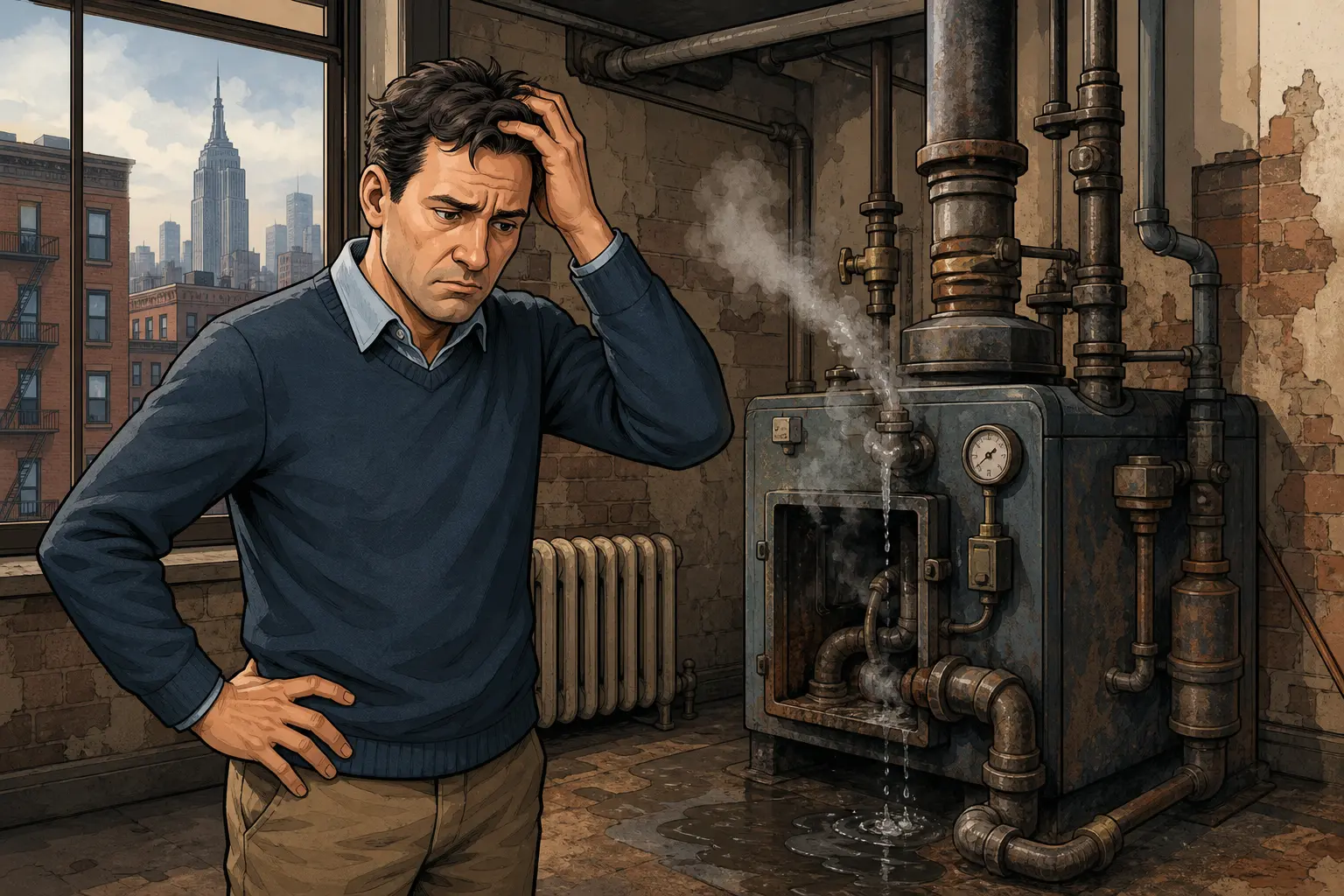
Most steam heat failures in pre-war NYC buildings trace back to a few recurring mechanical causes, not bad luck. Here's what actually breaks down and why.
That banging radiator isn't the building being old. It's a mechanical system telling you something specific is wrong, usually a stuck trap, a failing air vent, or water chemistry that's been ignored for years. Owners of pre-war buildings tend to write these complaints off as the price of having an old system. That assumption is exactly what turns a small, inexpensive repair into a mid-January boiler replacement nobody budgeted for.
Steam heat failures in buildings built before 1950 follow patterns. The piping layout, the boiler's age, the way the system was maintained (or wasn't) over the last few decades, these all point to a short list of root causes that show up again and again on service calls. Knowing which one is likely at play before a technician arrives helps a property manager make faster decisions when a no-heat call comes in at 11 PM in February, and it helps avoid the kind of citation that shows up when an inspector finds a system running on borrowed time.
The Hidden Toll of Decades-Old Steam Infrastructure
Age by itself doesn't kill a steam system. What kills it is the gap between what the system was built to do in 1928 and what the building actually asks of it now. Most pre-war steam setups were sized around the original layout: a certain number of radiators, a certain square footage, steam traveling through mains and risers engineered for that exact load. Combine a few apartments into one unit, finish a basement, add a commercial tenant on the ground floor, and the math the original engineer did no longer holds. The boiler's still rated for the old numbers. The pipes are still the old diameter. Nobody upsized anything because nothing visibly broke.
Pipe corrosion and mineral scale build up on the inside, where nobody's looking, long before there's a leak or a bang loud enough to complain about. A steel main can look fine from the basement ceiling and still be losing real diameter to rust on the inside wall. Same with the boiler's heat exchanger surfaces. Scale insulates the metal from the water it's supposed to be heating, so the system burns more gas to produce the same steam output. A walkthrough won't catch that. The gas bill will.
A lot of these buildings are still running main vents and traps that were never touched since the original install, sometimes never replaced, just patched or ignored. On its own that's not a failure, but it's inefficiency stacked on inefficiency, and it's exactly the kind of thing that turns a minor repair into a full system evaluation. Plenty of 80-year-old systems still run fine with regular attention. Age mostly just means less margin for error when something does go wrong. For a closer look at how these systems are supposed to perform when everything's matched correctly, see how high pressure steam heat exchangers are designed to work in NYC buildings.
Water Quality and Boiler Treatment Problems
Nobody calls a plumber because the boiler water "looks off." They call because a radiator is banging at 2am or a tenant's apartment won't hold heat. A good chunk of the time, though, the actual cause is sitting in the boiler itself, not the pipes or the radiator valve everyone's staring at.
Steam boilers need clean water and the right water level to make dry steam. When the water's full of dissolved minerals, oil residue, or sediment that's been settling for years, scale builds up on the heating surfaces. Scale acts like insulation in exactly the place you don't want insulation, so the boiler works harder and burns more fuel to make the same amount of steam. Left alone, that means premature wear on the sections, a burner working overtime, and equipment that quits well before it should.
There's also a near-boiler piping issue that gets missed constantly: wet steam and priming. If the water level's too high, or the boiler hasn't been skimmed to remove the oil film that sits on top of the water, the steam leaving the boiler carries water droplets with it instead of traveling as clean, dry vapor. That wet steam loses heat fast, condenses too early in the mains, and shows up as water hammer, cold spots in far radiators, or that hollow banging sound owners usually blame on "old pipes."
Owners usually treat the symptom instead of the cause. A knocking pipe gets insulated or a radiator gets bled, and the noise quiets down for a while. Nobody pulls a water sample. A simple flush and skim might solve it for a season, but if the same complaint keeps coming back building to building, that's usually a sign the system needs an actual treatment program, not another one-time fix. Testing water quality as part of routine plumbing and boiler service is a cheap way to find out which one applies.
Failing Vents, Traps, and Pressure Controls
Air vents are the part of a steam system nobody thinks about until they stop working. Every radiator has one, and the main lines running through the basement have bigger ones. Their job is simple: let the air inside the pipes escape so steam can actually fill the space. When a vent clogs with rust or mineral buildup, or the little bellows inside corrodes shut, air gets trapped. Steam can't push past it. That's why one radiator stays stone cold while the one next to it is fine, or why heat shows up in the bedroom an hour before it ever reaches the living room.
Traps cause a similar mess but for a different reason. They're supposed to let condensate (the water steam turns into) drain back out while keeping live steam from blowing through. A stuck trap either floods a line with water, which is what causes that banging and knocking everyone blames on "old pipes," or it fails open and lets steam race through where it shouldn't be, wasting fuel and overheating rooms that are already warm enough.
Pressure controls deserve more attention than they usually get. A pressuretrol or low-water cutoff that's worn, miscalibrated, or never gets tested will let the boiler short-cycle, or let pressure climb higher than it should. Residential steam systems are generally designed to run at very low pressure, often just a pound or two, and a failing control that lets it drift well past that isn't only a comfort problem. It's a safety issue, and it's exactly the kind of thing covered during routine boiler inspection and service visits.
One bad vent can look, from a tenant complaint, exactly like a failing boiler. Buildings sometimes end up pricing bigger repairs, or even a full boiler evaluation, before anyone checks the cheap vent that was the actual problem. Getting the diagnosis right the first time, through someone who can walk the system and check components in sequence, usually saves more than the repair itself costs.
How to Tell If It's a Repair or a Replacement Situation
Here's the question every building owner eventually asks a technician standing in the boiler room: fix it again, or start pricing a new system? The honest answer depends less on the age stamped on the boiler plate and more on what's been happening mechanically over the past couple winters.
A single pressuretrol failure doesn't mean much on its own. Repeated pressuretrol failures over a short stretch mean the boiler is running under conditions that keep cooking replacement parts, and that pattern is worth paying attention to. Repair spending follows a similar logic. When a building keeps writing checks for patch jobs season after season, at some point the running total starts to rival what a new system would cost, and that's usually the signal to stop patching and get a real replacement quote instead.
Timing changes the calculation too. A problem found in September gives a board or management company room to get bids, compare financing, and schedule the work before the first cold snap. The same problem discovered in January, with tenants already calling about cold radiators, usually forces a rushed decision and whatever equipment happens to be available fastest. Mid-winter failures rarely get the cost comparison they deserve.
Some signs point toward repair being enough, at least for now:
- One or two isolated trap or vent failures, not building-wide complaints
- A single control malfunction with no history of repeat failures
- Localized water hammer traced to a specific riser, not the whole system
- A newer boiler with a clean, documented maintenance history
Other signs lean toward replacement, especially when they show up together: an older boiler or heat exchanger nearing the end of its typical service life, recurring low-water cutoff trips, visible section leaks, or repair costs that keep climbing each visit despite different parts failing each time. A co-op board looking at its third pressuretrol replacement in two years is usually better off getting a real quote on a high-pressure heat exchanger than continuing to chase the symptom.
Building type matters here more than people expect. Co-ops need board approval and often a capital reserve discussion, which can take months. Rentals answer to ownership groups that may move faster if the numbers justify it. Commercial properties sometimes have lease clauses tied to heat reliability that push the timeline regardless of budget comfort. None of that should get decided by guesswork. An actual inspection, the kind that checks combustion efficiency, pressure readings, and wear on components, should drive the call rather than an assumption based on the building's age alone. A documented inspection of the high-pressure steam heat exchanger and boiler gives owners that decision-ready read before committing either way.
What Property Managers Miss During Routine Inspections
A boiler can pass its annual inspection and still be two winters away from a bad failure. That catches a lot of property managers off guard. The city's compliance inspections, the ones tied to boiler certificates and Local Law requirements, check specific safety items: proper operation of low-water cutoffs, safety valves, combustion readings, visible signs of a cracked section. They aren't a full mechanical workup of the steam distribution system running through sixty risers and two hundred radiators.
A diagnostic assessment is a different job. It looks at how steam is actually moving through the building: which traps are stuck open or closed, whether the main vents are sized right for the current load, what the water chemistry looks like under a microscope rather than just whether the gauge glass shows the right level. None of that is required for compliance sign-off, and most inspectors doing the compliance walk aren't being paid to dig that deep.
So the gap sits there quietly. A pressuretrol drifting out of calibration, a riser slowly losing pitch as the building settles, corrosion building inside a return line nobody's opened in a decade. None of it shows up on paper until it shows up as a tenant calling about a cold apartment on the 4th floor or a flooded basement from a failed trap.
Tenant complaints feel like the first warning sign. They're usually the last one. By the time a banging radiator wakes up a whole floor, the underlying issue has typically been developing for a heating season or two already. Buildings that rely on compliance inspections alone, and skip the more detailed mechanical review, tend to find out about problems the expensive way: mid-January, during a cold snap, with a building full of tenants who don't care why the boiler failed. Pairing the required inspection with an actual diagnostic look at the steam distribution and heat exchanger system closes a lot of that gap before it turns into an emergency call.
Getting Ahead of Failures Before Peak Heating Season
September and early October is when a pre-season steam check actually matters, not December. Once outdoor temps drop and every building in the borough fires up its boiler at the same time, service companies get slammed and response windows stretch from same-day to "we'll try to get there Thursday." If a main burner control fails on a 10-degree night in January, that's not a great moment to find out your usual contractor is booked solid through the cold snap.
A pre-season visit from a licensed contractor should cover more than a quick look and a signature on a form. At minimum it should include:
- Testing the low-water cutoff and checking for sediment buildup in the float chamber
- Inspecting and cleaning main and radiator air vents
- Checking steam traps for stuck-open or stuck-closed conditions
- Verifying pressuretrol settings and cutoff differentials
- Pulling a water sample to check for contamination or skimming needs
- Reviewing combustion efficiency and checking for proper draft
Before hiring anyone for this kind of work, ask specifically about experience with high-pressure steam systems, not just general boiler service. A lot of HVAC companies in this city handle hot water systems and residential furnaces fine but rarely touch high-pressure steam, which runs differently and fails differently. Ask how many pre-war buildings they service regularly, whether they carry a master plumber license, and whether they handle both the mechanical side and the compliance paperwork if something needs reporting.
Waiting until the first cold week to make that call almost always means worse pricing, slower response, and a tenant complaint list that's already piling up. Buildwise Plumbing Heating & Contracting handles pre-season inspections and high-pressure steam system service for buildings across NYC. Scheduling one now, before the rush, is the simpler way to head into winter.
Frequently asked questions
Why is the steam radiator not heating?
Nine times out of ten it's a failed air vent or a stuck trap. Air gets trapped inside the radiator and steam can't push past it, so the unit stays cold while the one next door heats fine. If the vent's bellows corroded shut or the trap flooded with condensate, the fix is usually swapping that one part, not touching the radiator itself.
My water boiler pipe is leaking. What could be causing this and what should I do?
In pre-war buildings, leaks usually trace back to internal corrosion or scale that's been eating pipe diameter from the inside for years before it ever shows on the outside. Water chemistry that's never been tested is a common culprit. Get a water sample pulled and have a tech check the main for wall loss before patching anything, since a patch on a corroded section rarely holds for long.
What are the most common boiler problems?
Scale buildup on heat exchanger surfaces, wet steam from poor water level or skimming, and worn pressure controls top the list in older buildings. Scale insulates the metal so the boiler burns more gas for the same output. A pressuretrol or low-water cutoff that's never been tested can let bigger problems run unchecked until something fails outright.
What causes that banging and knocking in steam pipes?
Water hammer, almost always. Either a stuck trap is letting condensate pool in a line that live steam then slams into, or wet steam leaving the boiler is condensing too early in the mains. Owners usually insulate the pipe or bleed a radiator and call it fixed. The noise comes back because nobody addressed the trap, the water level, or the skimming that caused it.
Is it worth repairing an old steam system or should I replace it?
Depends on what's actually failing. A stuck trap, a bad vent, or untreated water are inexpensive fixes that can keep an 80-year-old system running fine for years. The math changes if the building's load has grown past what the original boiler and piping were sized for, since no amount of part-swapping fixes undersized mains.