
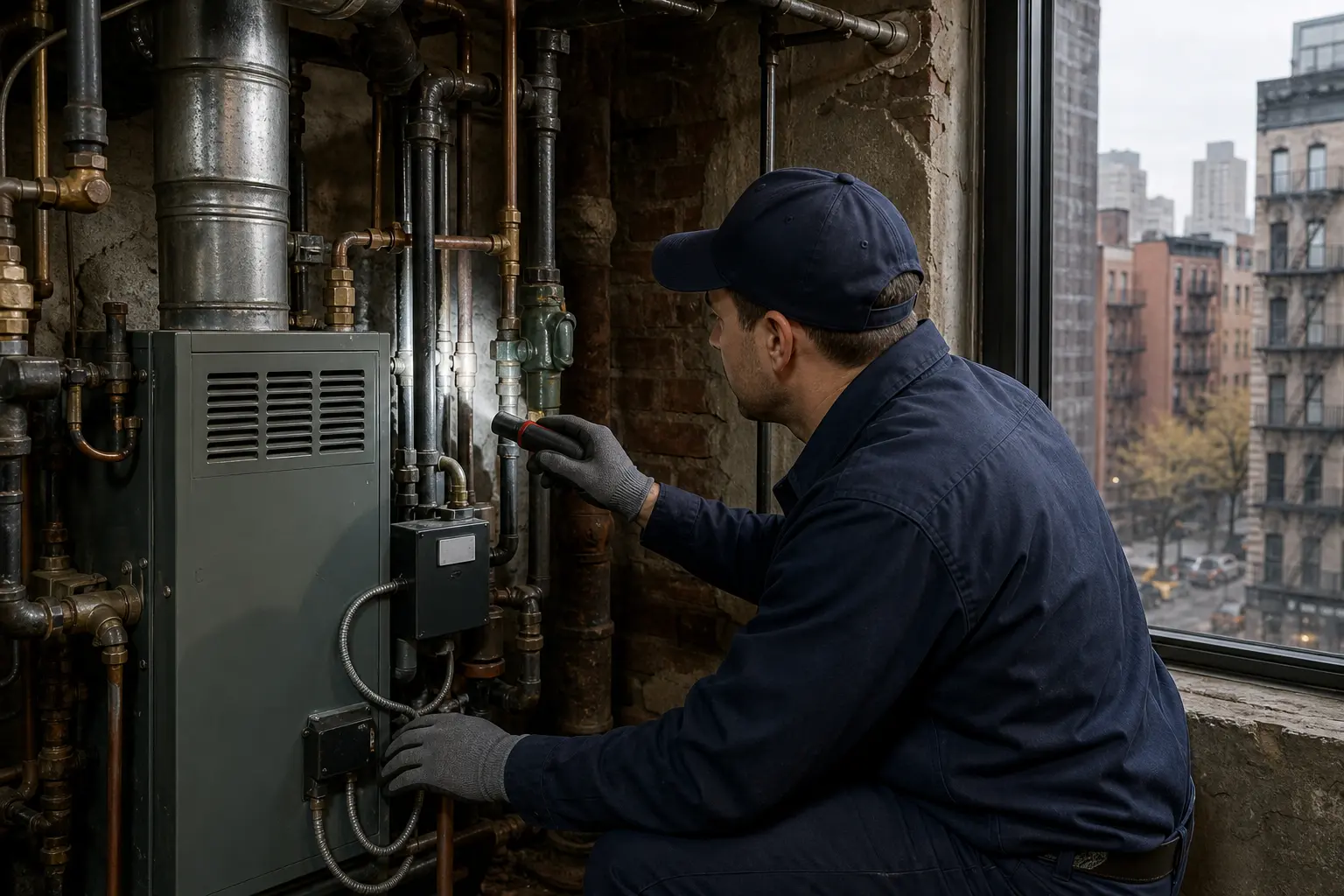
Starting this heat season, HPD will attempt inspections at each apartment associated with a non-anonymous heat or hot-water complaint, subject to its duplicate-complaint rules. Here’s what gas-related issues can turn a routine heat check into a bigger problem.
An inspector who's there to check a radiator isn't going to ignore a gas meter that looks wrong, a suspicious shutoff, or a boiler room that smells like it shouldn't. Heat complaints get inspectors into the building. Once they're in, they're looking at whatever's visible, and a gas violation that's been sitting quietly on the books can turn a routine heat complaint into something a lot more involved.
Why Heat Complaints Open the Door to Gas Violations
An HPD inspector responding to a no-heat complaint isn't just checking the thermostat on the radiator. Once they're in the building, they're looking at whatever's visible, and that includes gas meters, risers, and anything that looks like unpermitted work. A tenant complains their apartment is 58 degrees, the inspector walks the basement to check the boiler, and now they're also noticing a meter that doesn't match what's on file or a riser that looks like it was never inspected. That's a separate violation, opened on a separate track, and it has nothing to do with whether the heat eventually comes back on.
A heat violation and a gas violation are not the same thing, and clearing one doesn't touch the other. An owner can get the boiler running again, satisfy HPD on the heat complaint, and still have an open gas violation sitting there that nobody addressed. In some cases, if Con Edison or National Grid finds something unsafe during their own check — a suspected illegal conversion, bootleg piping, tampering — they can shut off gas service independently of HPD, and that shutoff isn't automatically tied to whether HPD's file is open or closed. No gas, no boiler, no heat, and now it's a utility matter instead of a housing matter, which often takes longer to resolve.
Inspectors and utility techs are trained to flag things like:
- Meters that don't match the building's filed gas plan
- Risers or branch lines that look altered or unpermitted
- Illegal conversions from oil to gas done without sign-off
- Shutoff valves that are missing, painted over, or inaccessible
- Any sign of jumpered or bypassed meters
Any one of those can stall heat restoration even after the mechanical problem is fixed. Buildings with known or suspected issues on this front are worth having checked by a gas specialist who handles violation removal before HPD or the utility finds it first.
The Gas-Related Items HPD and Utilities Actually Check
Worth separating a few things here, because a lot of owners lump them together. HPD, the gas utility (Con Edison or National Grid, depending on the borough), and DOB all have separate roles, and passing one check doesn't mean you're clear with the others. HPD inspectors responding to a heat complaint are generally focused on the heat and hot water violation itself, but anything gas-related in plain view can get noted and referred out. The utility runs its own gas safety inspections tied to meter access, leak checks, and periodic compliance sweeps, and has the authority to shut off service on the spot if it finds something it considers dangerous.
On top of that, DOB requires its own periodic gas inspection under Local Law 152. This law generally requires gas-piping inspections every four years for covered buildings, with deadlines based on Community District rather than just the borough. One- and two-family homes and other R-3 buildings are exempt. Covered buildings without gas piping must submit the required no-gas-piping certification to DOB — it isn't an automatic pass. A landlord can pass an HPD visit and still get a red tag from the utility a week later, or still owe DOB a Local Law 152 filing regardless of what HPD found.
What tends to get flagged, across HPD, the utility, and DOB inspections, usually falls into a short list:
- Corroded, patched, or exposed gas piping, especially in basements and mechanical rooms
- Missing or painted-over shutoff valves that can't be operated in an emergency
- Meters that don't match utility records — a sign of an illegal conversion or an installation nobody permitted
- Gas lines that were clearly rerouted or capped without a visible permit or sign-off
- Flex connectors or appliance hookups that look improvised rather than installed by a licensed contractor
Buildings that went through recent renovations or apartment combinations tend to draw more scrutiny, fairly or not. Combining two units often means someone moved a kitchen or added a line, and if that work wasn't permitted the way it should've been, it shows. Same goes for any building with a prior violation on record, even one that's already been resolved and closed out. Inspectors doing heat season sweeps often pull the history before they walk in, and a building that's had issues before tends to get a closer look this time around. Owners dealing with a line that's aging out or already showing damage might find it useful to understand the repair-versus-replacement decision before an inspector forces the issue for them.
A Walkthrough: What to Check in Your Building This Week
Here's the order that actually makes sense, and it's not the order most owners start with. Pull the violation history first. Open and resolved violations can be searched by address through city building and housing records, and it only takes a few minutes. If there's an old gas violation sitting there from two years ago that never got signed off, that's priority one, before anything else on this list.
Next, walk the building and look at what's visible. Gas meters in the basement, risers going up through shafts, any flex connectors feeding appliances in individual units if there's access. Look for rust, soft corrosion spots, tape or fittings that look improvised, meters that don't match what's on record. This part costs nothing and anyone with keys can do it.
Then comes the step most owners skip entirely: matching permits to actual gas use. If a tenant or a prior owner added a gas dryer hookup, a second stove, a patio heater line, anything that increases load on the system, there should be a permit on file for it. Pulling records to check this takes real time, and most landlords without maintenance staff just don't do it. It's not laziness. Nobody told them it mattered until an inspector flags an unpermitted line behind a wall panel that's been there since a renovation a decade ago, still live, never pulled a permit.
Last, check the boiler room itself. Clear access, posted signage, nothing stored against the unit blocking a shutoff valve. That's a quick HPD and FDNY flag even outside of gas issues.
A visual walkthrough catches the obvious stuff. It won't catch internal pipe corrosion or a slow leak behind a finished wall. If the visual check turns up anything questionable, or the building's gas system is old and hasn't had a licensed inspection in a while, that's worth doing now, while there's still time before a tenant complaint brings an inspector through the door anyway.
What Happens If HPD Finds a Gas Violation Mid-Season
Once a violation gets issued, there's a correction window attached to it, with a re-inspection typically scheduled after. That timeline sounds manageable in June. In heat season, with DOB and HPD both buried under complaint volume, the re-inspection date can land weeks later than it would the rest of the year, depending on the violation class and the agency's current backlog. The violation sits open the whole time, and so does whatever risk caused it.
If the issue is an active gas hazard rather than paperwork, the utility can move to shut off gas quickly, sometimes the same day someone identifies the leak or improper connection. It doesn't wait for a convenient week, and it doesn't care that it's 40 degrees outside and tenants need hot water. Gas typically stays off until repairs are made and the system passes inspection again, which can leave an apartment or an entire building without cooking gas or hot water heat for however long that takes to sort out.
Penalties work differently depending on which violation you're dealing with. HPD may seek daily civil penalties for heat or hot-water violations from the date the Notice of Violation is posted until correction, subject to applicable rules. Gas violations are a separate matter, tied to DOB or utility enforcement, and whether a fine accrues daily, is a flat amount, or escalates depends on the violation class and agency involved. There's no single number that applies across the board, and it's worth checking the specific violation type rather than assuming one penalty structure covers everything. What's fairly consistent is that emergency repair work, done under pressure with a shutoff already in place, tends to cost more than the same job scheduled on a normal timeline. Rush labor, after-hours calls, parts sourced same-day instead of ordered ahead.
Owners who already have a licensed gas plumber on file move through this faster. There's no time lost finding someone qualified, pulling permits, or explaining the building's history from scratch. If a property hasn't had recent gas line work done and isn't sure who'd handle a violation if one showed up, that's worth sorting out now, not after a shutoff forces the question.
Getting Ahead of It Before the First Cold Complaint
A gas inspection booked now is a scheduling decision, not an upsell. Getting a plumber in before the complaint comes in costs less and takes less time than dealing with a violation once HPD's already on site and the correction clock is running. An hour or two this week beats weeks of re-inspection delays in January.
Not every plumbing company that does inspections also handles violation removal and the paperwork that goes with it. Some will inspect, hand over a report, and consider the job done. If something shows up, the owner is back to square one hiring a second company that then has to re-verify what the first one found. Ask upfront whether the company does both, start to finish, so there's no gap between finding a problem and fixing it.
A few questions worth asking before hiring anyone for this:
- Are they licensed to do gas work in NYC, and can they show the license number without hesitation?
- Have they actually removed gas violations before, or just inspected for them?
- What's their response time if something turns into an emergency mid-inspection, like a riser that's clearly compromised?
- Do they file the correction paperwork themselves, or does that fall back on the owner?
Run through the violation history check and the walkthrough covered earlier, then get someone licensed in to look at what's harder to assess without training: meters, risers, anything that looked off. A gas violation inspection and removal service can usually handle the inspection and the correction paperwork under one point of contact, but depending on what's found, the actual repair work, permitting, and sign-off may still run through several stages rather than wrapping up in a single visit. Starting now, before heat season complaints are stacking up, leaves room for that process to play out on a normal timeline instead of an emergency one.
Frequently asked questions
What are the requirements for gas piping inspections in New York City?
Gas piping in NYC buildings has to match what's on file with the utility and with the city's building records. Inspectors check for corrosion, exposed or patched sections, missing shutoff valves, and any piping that looks rerouted without a permit sign-off. Separately, Local Law 152 generally requires gas-piping inspections every four years for covered buildings, with deadlines based on Community District. One- and two-family homes and other R-3 buildings are exempt. Covered buildings without gas piping must submit the required no-gas-piping certification to DOB. If your building's had a renovation or apartment combination recently, that piping gets a closer look, since unpermitted kitchen moves are a common source of violations.
Can I run a gas line on the outside of my house?
Exterior gas lines are allowed in some cases, but they still need to be installed by a licensed contractor and match what's filed with the utility. An exposed line that wasn't permitted, or one that looks improvised, is exactly the kind of thing that gets flagged during a heat season walkthrough and can lead to a shutoff even if the piping itself isn't actively leaking.
Do gas lines need to be inspected?
Yes, and in NYC that involves more than one agency. HPD inspectors responding to heat or hot water complaints will note anything gas-related they spot in plain sight, like a bad meter or a missing valve, and refer it out. Con Edison and National Grid run their own periodic gas safety checks tied to meter access and leak detection, and can shut off service on the spot if they find something unsafe. Separately, DOB requires periodic gas-piping inspections under Local Law 152 for covered buildings, generally every four years, with deadlines set by Community District and exemptions for one- and two-family homes and other R-3 buildings.
What are the requirements for gas safety inspections in New York State?
Utilities handle periodic compliance sweeps looking for corroded or altered piping, meters that don't match their records, and appliance hookups that weren't installed by a licensed contractor. These inspections run independently of HPD's housing-code enforcement and DOB's Local Law 152 cycle, which means passing an HPD heat check doesn't mean you're clear with the utility or with DOB. A red tag from Con Edison or National Grid can still shut off your gas a week later, and a missed Local Law 152 filing can sit open regardless of whether heat and hot water are working fine.
What happens if HPD finds a gas violation during a heat complaint visit?
The gas violation gets opened on its own track, separate from the heat violation. Fixing the boiler and restoring heat doesn't close out a gas issue sitting in the file. And if the utility independently decides something's unsafe, like a suspected illegal conversion or a tampered meter, they can cut gas service regardless of where HPD's case stands, which turns a housing problem into a utility problem that usually takes longer to resolve.