(And How to Avoid Joining the List)
Nobody wakes up excited about a gas piping inspection. It's not exactly a spa day. But if you own or manage a building in New York City, Local Law 152 inspections are now a fact of life — and a surprising number of buildings are failing them for completely avoidable reasons.
The good news? Once you know what inspectors are actually looking for, most of these issues are easy to spot (and fix) before they turn into a violation, a red tag, or an awkward call from Con Edison telling you your gas is getting shut off. (Local Law 152 applies to most NYC buildings other than one- and two-family homes and other buildings classified as Occupancy Group R-3 — if that's not your building, this is the list to know.)
Here are the five most common reasons NYC buildings fail their gas inspections — starting with the one that causes the most headaches.
1. Illegal or Unpermitted Gas Work
This is the big one. If gas piping was installed, moved, or modified at any point without a DOB permit — or by someone who wasn't a licensed master plumber — it's going to show up during inspection, and it's not going to end well.
This happens more often than you'd think, especially in older buildings that have been renovated multiple times over the decades by whoever the previous owner's cousin's contractor happened to be. Unpermitted work is frequently flagged as a serious violation, and “but it was already like that when I bought the building” is not a defense the DOB accepts.
The fix:Any gas work should be done — and documented — by a licensed master plumber, with proper permits filed. This applies whether it's a full plumbing renovation or a small repair. If you're not sure whether past work was permitted, it's worth checking before an inspector finds out for you.
2. Corroded or Damaged Piping
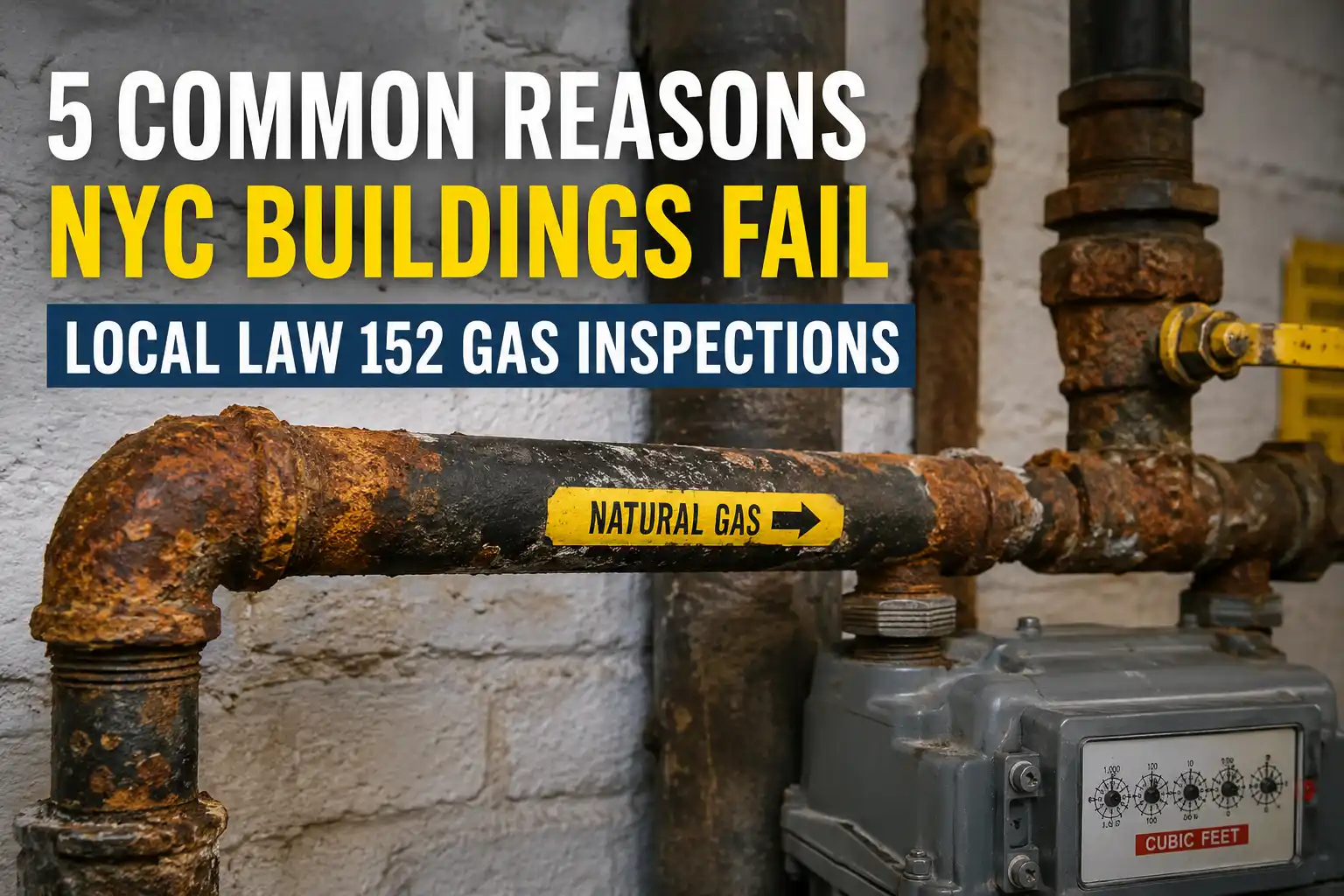
Gas pipes don't last forever, and NYC's aging housing stock doesn't do them any favors. Moisture, age, and outdated materials all contribute to corrosion — and corroded piping is one of the fastest ways to fail an inspection.
Pre-war buildings and older brownstones are especially prone to this, simply because their piping has been sitting there quietly aging since before some of our grandparents were born. Charming architecture, less charming plumbing.
The fix:Visible corrosion, rust, or pitting on gas piping should be addressed proactively, not after an inspector points it out with a clipboard and a disappointed expression.
3. Improper Pipe Support or Bracing
Gas piping isn't supposed to just sort of... hang there. Code requires specific support, spacing, and bracing to keep pipes secure and stable. When piping sags, dangles, or is held up by what appears to be optimism alone, that's a fail.
This is one of the more “how did nobody notice this” violations — often the result of piecemeal work over the years where nobody circled back to double-check that everything was properly secured.
The fix:A quick visual check for sagging or unsupported sections can catch this early. If it looks like it's being held up by hope and duct tape, it probably needs attention.
4. Active Gas Leaks Detected During Testing
This is the one nobody wants to hear about. Inspectors check for leaks using a portable combustible gas detector as they move through the building — sometimes it picks up a minor issue at a single fitting, sometimes a sign of a bigger systemic problem.
Either way, an active leak isn't just an inspection failure; it's a safety issue that needs immediate attention. This is also the fastest route to a red tag or a gas shutoff if it's not addressed quickly.
The fix:If you ever smell gas or suspect a leak, don't wait for an inspection to confirm it — call a licensed plumber right away. If a leak does turn into a formal violation with Con Edison or National Grid, getting it removed quickly matters more than anything else on this list. For everything else, regular maintenance checks go a long way toward catching small leaks before they become large problems (or news stories).
5. Blocked Access to Meters, Shutoff Valves, or Piping
Inspectors need clear access to gas meters, shutoff valves, and exposed piping to actually inspect it. If someone's storage boxes, a renovation wall, or that bike nobody rides anymore is blocking the way, the inspection can't be completed properly — which puts your certification at risk even if the piping itself is fine.
The fix:Keep meters and shutoff valves visible and reachable. It costs nothing and takes five minutes, making it the easiest win on this entire list.
What Does a Passed Inspection Look Like?
It's worth knowing what success actually looks like, since it's a lot less dramatic than a failure.
During the inspection, the licensed master plumber — or a Registered Journeyman Plumber with the required DOB training, working under the plumber's direct supervision — walks through all exposed gas piping — from where gas enters the building, through meter rooms, hallways, corridors, and mechanical or boiler rooms — checking for corrosion, damage, improper supports, and illegal connections, and using a combustible gas detector to check for leaks along the way. No pressure test is required for this periodic inspection, though separate gas repair or alteration work may require one. As of the DOB's 2026 rule updates, the inspecting plumber must also notify DOB at least two business days before the inspection takes place.
If nothing gets flagged, here's what happens next:
- Within 30 days, the plumber provides a Gas Piping System Periodic Inspection Report (GPS1) confirming no corrective conditions were found.
- Within 60 days of the inspection, the building owner files the Gas Piping System Periodic Inspection Certification (GPS2) with the DOB through their online portal. As of the DOB's 2026 rule updates, this filing now carries a $35 fee — a change from the fee-free process in earlier cycles.
- No violation is issued, and no further action is needed until the next inspection cycle, roughly four years later based on the building's community district.
A passing inspection doesn't involve pressure testing the system, and it doesn't extend into individual apartments — only common and exposed areas fall under the inspection's scope. In short, a passing inspection is a quiet non-event: a report gets filed, a certification gets submitted, and the building's compliance clock resets for another four years. It's the failing inspections that turn into paperwork and phone calls.
What Happens If You Fail?
Failing an inspection doesn't automatically mean a violation lands on your building that day. If conditions requiring correction are found, the owner still has a defined window — generally 120 days from the inspection, or up to 180 days with an approved extension — to fix the issue and file a corrected certification. Violations and civil penalties come into play when that window is missed, when required filings don't happen, or when a hazardous condition isn't addressed. Those penalties aren't small: DOB's current schedule runs $1,500 for 1-3 family buildings and $5,000 for everything else, per missed filing. Ignore the process entirely, and you risk escalation — including a red tag or gas shutoff, which is a considerably bigger (and more expensive) problem than the original issue ever was.
The bottom line: most gas inspection failures come down to things that were either done wrong years ago, or neglected slowly over time. None of them are surprises once you know where to look.
Not sure if your building would pass a Local Law 152 inspection today?Buildwise Plumbing, Heating & Contracting can take a look before the DOB does — and if you've already got a violation or red tag, we can help clear it fast. Reach out to schedule an inspection.
Frequently Asked Questions
How often does my building need a gas piping inspection?
Under Local Law 152, buildings are required to have gas piping systems inspected periodically, with deadlines assigned by community district. Most buildings need to be re-inspected roughly every four years, though it's worth confirming your specific deadline since the schedule is staggered across the city.
What is a gas violation, and how serious is it?
A gas violation is issued when an inspection finds an issue with the piping system, ranging from paperwork problems to active safety hazards. Violations are typically classified by severity, with the most serious ones (like active leaks) requiring immediate correction to avoid a red tag or gas shutoff.
Can I fix a failed inspection myself?
No — any corrective gas work must be performed by a licensed master plumber and, in most cases, filed with the DOB. Even minor-seeming fixes, like re-securing a pipe, need to be done and documented properly, or you risk failing the re-inspection too.
How long do I have to fix a violation before my gas gets shut off?
For non-hazardous issues found during inspection, you generally have a defined window (commonly cited as 120 days from the inspection date) to make corrections and file an updated certification. Immediately hazardous conditions, like an active leak, are a different story — those must be addressed right away, and the utility or DOB may require gas service to be shut off until it's fixed.
What should I do if I smell gas in my building?
Leave the area immediately — don't stop to flip a light switch, use your phone, or touch any appliance, since even a small spark can ignite gas. Once you're safely outside, call 911 and your gas utility (Con Edison or National Grid). A licensed plumber comes in after the area has been made safe to handle repairs, permits, and getting service restored.