
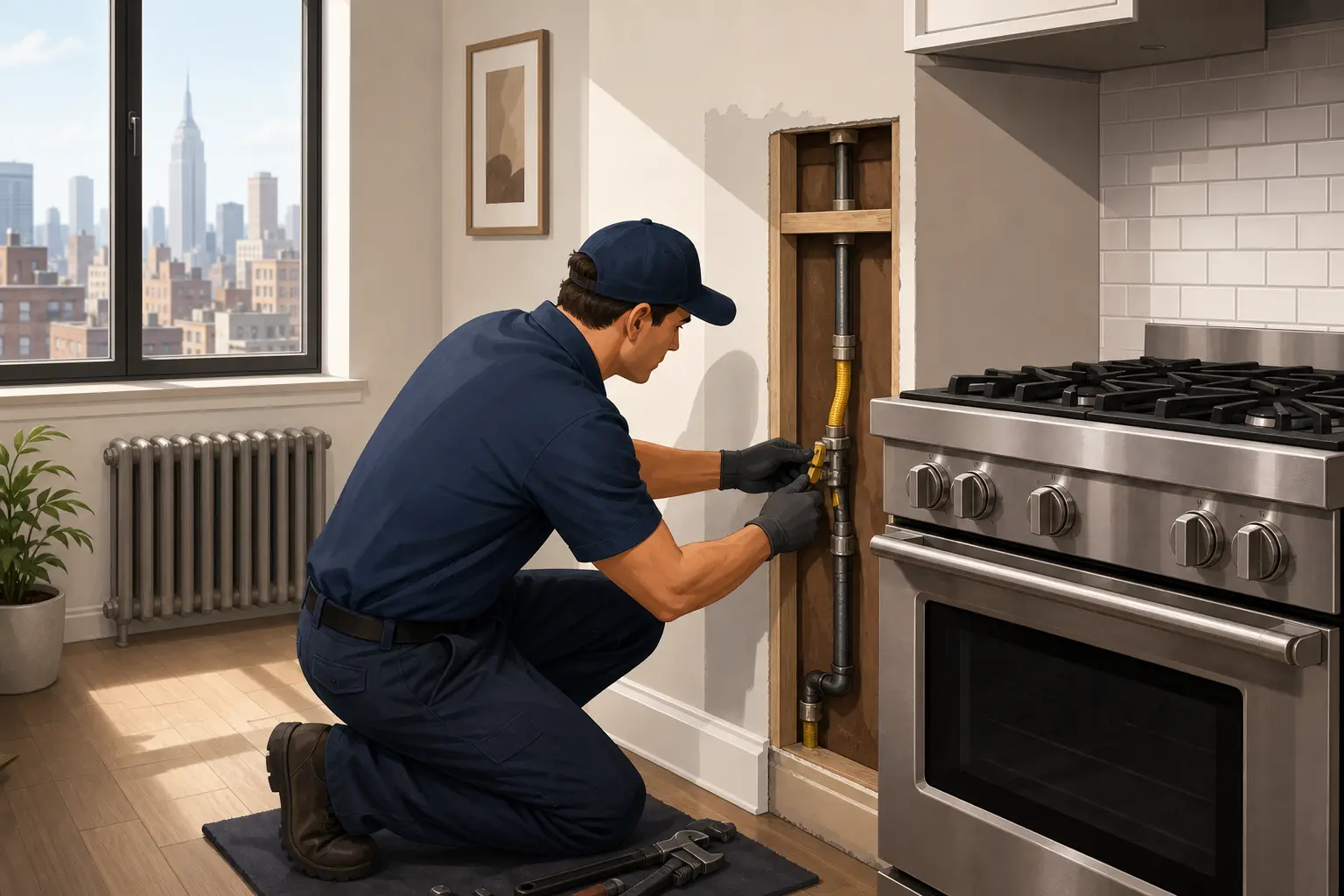
A new gas range delivery day can turn into a stalled job if the existing gas line isn't sized or rated for it. Here's what NYC homeowners need to check before the stove shows up.
Most kitchen renovations hit this snag: the new range gets delivered, the installer connects it, and then refuses to turn on the gas because the existing line isn't rated for the appliance's BTU load. That's not the delivery crew being difficult — it's them following gas code, and it means the job stops right there until a licensed plumber gets involved.
A lot of NYC buildings, especially pre-war walk-ups and older brownstones, were piped decades ago for a smaller stove or no stove at all. Swapping in a higher-output range, adding a griddle attachment, or converting from electric to gas almost always means the line, the shutoff valve, or both need work before the city will sign off. Skip that step and you're looking at a failed inspection, a stove sitting in a box in the hallway, or a red tag from the utility that shuts down gas to the whole unit.
Why Your Old Gas Line May Not Be Ready
The old line worked fine for the apartment's previous owner, or for whatever modest range has been sitting there since the last renovation. That doesn't mean it's rated for a high-output professional-style range someone just had delivered. Pipe diameter and length determine how much gas can actually move through the line at the pressure the appliance needs. A stub that's been capped and reopened a few times, or that was sized for a smaller unit, can choke a new high-output range even though gas technically "works" at that outlet.
Age shows up in other ways too. Flex connectors have a service life, and reusing an old one on a new appliance is something most manufacturers' installation instructions and plumbers advise against, often for warranty reasons as much as code. Shutoff valves that predate current code, or that show corrosion, pitting, or a stiff handle that won't turn smoothly, are a red flag a plumber will flag during rough-in. None of this is visible from the kitchen side until someone pulls the stove out and looks.
A few things worth checking, or asking a plumber to check, before assuming the existing line is fine:
- BTU rating of the new range compared to what the old line was sized for
- Age and condition of the flex connector and shutoff valve
- Visible corrosion, rust staining, or patched fittings on the line
- Whether the building is a co-op or condo with a shared riser that may already be near capacity
- Any past gas work on the unit that wasn't permitted or inspected
Co-op and condo buildings add a layer most homeowners don't think about. Even if the in-unit line and valve check out, the riser and meter capacity for the whole building might not support added load across multiple units upgrading appliances. A single-unit look won't catch that — it usually takes someone familiar with gas line installation and repair across NYC properties to trace it back to the main and confirm there's room.
Permits and Inspections NYC Won't Let You Skip
Swapping a small residential range for a professional-style one with a much higher BTU draw often means running a new or larger gas line, and in NYC that's not a job the plumber just quietly handles on their own authority. A like-for-like swap, same connection point, same line size, usually doesn't trigger a DOB filing. In general, changes like a new line run, a larger diameter, or a rerouted path through a wall or floor tend to require filing, though the exact determination depends on the scope of work and is something the plumber or a licensed filing agent should confirm with DOB rather than assume. The Department of Buildings needs to sign off on the work itself, and separately, the utility (Con Edison or National Grid, depending on the borough) has to inspect and approve before gas service gets turned on or restored at the meter. Those are two different approvals from two different agencies, and one doesn't substitute for the other.
A lot of property owners assume that because they hired a licensed plumber, the permit question is handled or unnecessary. Licensing covers who's allowed to do the work. It doesn't cover whether DOB needs to be notified about what the work is. Those are separate questions, and a contractor who's cutting corners on paperwork is a bigger liability to the property owner than it might seem in the moment.
Skipping the inspection doesn't just risk a fine. If there's a leak or a fire down the line, an uninspected install can leave the owner in a much weaker position, since there's no record proving the work passed code. Worth knowing before scheduling: the permit and inspection timeline often runs longer than the actual pipe work, so building that lag into the renovation schedule matters more than people expect. Buildwise Plumbing Heating & Contracting works with property owners on gas line installs that need DOB and utility sign-off before a stove can legally run.
What Actually Happens During a Gas Line Upgrade
Once the permit question is settled, the actual work follows a pretty fixed order. Knowing the sequence helps with scheduling, because the parts that feel like they should take an hour sometimes take a week, and the parts that sound complicated are often done before lunch.
- Walk-through assessment of the existing line, meter, and appliance connection point
- Gas shutoff at the meter or house valve
- Line sizing calculation and replacement or extension of pipe to match the new appliance's BTU load
- Pressure test on the new section to confirm there's no leak before anything gets connected
- Utility or DOB inspection, depending on scope
- Final reconnect and appliance hookup once the inspection clears
The assessment, shutoff, and pipe work itself can usually happen in a single visit, sometimes the same day, if the job is a straightforward run from an existing branch. Where things stretch out is the inspection step. If the scope required a DOB filing, the new line has to pass inspection before it gets turned back on and connected to the stove. That's not something a plumber can accelerate just because a delivery truck is already on its way.
A property manager books a new range delivery for Friday without confirming the line upgrade and inspection can actually happen before then, and the building ends up without cooking gas for the weekend because the inspector isn't available until Monday. Lining up the delivery date against the inspection date, not just the installation date, avoids that gap.
Pressure testing isn't a step anyone should skip or rush. It's the only way to confirm the new joints and fittings are actually sealed before gas starts flowing to the appliance, and it's usually required as part of the inspection record anyway. For more on how pipe material affects this part of the job, see the comparison of copper and black iron gas pipe.
Signs You Need a Pro Before You Buy the Stove
The BTU check should happen at the appliance showroom, not in the kitchen after delivery. Every range has its total BTU input listed in the spec sheet, usually buried near the dimensions. That number needs to get compared against what the existing line can deliver before any money changes hands. A licensed plumber can tell in a short visit whether the current setup covers the new range or chokes well below what it needs. Skipping that step is how installers end up refusing to hook up a brand-new range sitting in the middle of the kitchen.
Swapping the flex connector feels like a fix anyone can handle, and for some appliance moves it is. But a new connector doesn't change pipe diameter, doesn't change how far the gas has to travel from the meter, and doesn't touch whatever code issue might be sitting upstream. If the old range ran fine and the new one just needs more fuel, the connector was never the bottleneck to begin with.
A few situations almost always call for a plumber's opinion before the purchase:
- The new range's BTU rating is noticeably higher than the old one, especially jumps into professional-style ranges
- The kitchen is in a rental or co-op/condo unit, where any line work needs landlord or board sign-off before a plumber can even start
- The space is a commercial kitchen, café, or food cart setup, which falls under stricter line sizing and ventilation rules than a residential apartment
- There's any uncertainty about what the current line is even rated for, because nobody kept records from the last renovation
Tenants in particular get stuck here. They don't have the authority to approve gas line work on someone else's building, and boards often require their own insurance paperwork and contractor approval before anyone touches a riser. Commercial spaces add another layer entirely, since a restaurant kitchen's gas demand and makeup air requirements rarely map onto residential code. Getting a read from a licensed plumber before signing off on an appliance usually saves a return trip and a restocking fee.
Getting It Done Right the First Time
Licensing and insurance on a gas line job aren't just boxes a contractor checks before sending a quote. If something goes wrong down the line, an improperly installed fitting leaks, a weld fails, the person who signed off on the work and their insurance are what stands between the property owner and a much bigger bill. Unlicensed work on a gas line can also complicate an insurance claim if there's ever a fire or carbon monoxide incident traced back to it, since insurers typically ask for proof the work was permitted and performed by a licensed trade. That's not a risk worth saving a few hundred dollars on.
Before hiring anyone, it's worth asking a few direct questions:
- Who pulls the DOB permit, and is that cost included in the quote or billed separately?
- Who schedules the required inspections, and how long does that typically take in this part of the city?
- What's the realistic timeline from first visit to final sign-off, including any wait time for inspection slots?
- Does the quote cover the full scope, line upsizing, meter coordination with the utility, appliance reconnect, or are those add-ons?
A contractor who hesitates on any of these, or who treats the permit as optional, is worth a second look.
It's also a good time to mention anything else going on with the building's plumbing. If there's an aging water heater, a slow leak, or an upcoming Local Law 152 inspection deadline, folding that into the same visit often saves a second service call and a second trip charge.
Anyone planning a kitchen renovation around a new range should get the gas line looked at before the appliance is ordered, not after it's sitting in the kitchen with no way to connect it. Buildwise Plumbing Heating & Contracting provides licensed gas line installation and repair for NYC residential and commercial properties, and can advise on what the permit and inspection process will look like for a given building before work starts.
Frequently asked questions
How much does it cost to have a gas line put in for a gas stove?
It depends on whether you're extending an existing line or running a new one, and whether the job needs a DOB filing. A simple swap at the same connection point costs a lot less than a rerouted line through a wall or floor, since that scope usually triggers permits and inspections on top of the pipe work itself. Get a plumber to look at the actual line before assuming a number.
What size gas line do I need for a gas stove range?
It comes down to the BTU rating of your new range compared to what the existing pipe was sized for. A line that was fine for a modest stove can choke a high-output professional-style range even if gas still technically flows at the outlet. Pipe diameter and length both affect how much gas moves through at the pressure the appliance needs, which is why a plumber runs a sizing calculation rather than guessing.
Do plumbers install gas lines for stoves?
Yes, and in NYC it needs to be a licensed plumber, since gas work follows code that delivery crews and installers aren't authorized to touch. But licensing only covers who's allowed to do the work, not whether DOB needs to be notified about it. Those are separate questions, and a plumber familiar with NYC filings should flag which one applies to your job.
Is it hard to run a gas line for a stove?
The physical pipe work is often the fastest part, sometimes done in a single visit if it's a straightforward extension off an existing branch. What stretches the timeline is the paperwork: if the scope requires a DOB filing, the new line has to pass inspection before it gets reconnected and turned on. That lag can run longer than the plumbing itself, so it's worth building into your renovation schedule early.
Does a co-op or condo need separate approval for a gas line upgrade?
Possibly, beyond what your own unit needs. Even if your in-unit line and shutoff valve check out fine, the building's shared riser and meter might already be near capacity if other units are upgrading appliances too. A plumber working only inside your kitchen won't catch that. It usually takes someone who traces the line back to the main to confirm there's room before signing off.