
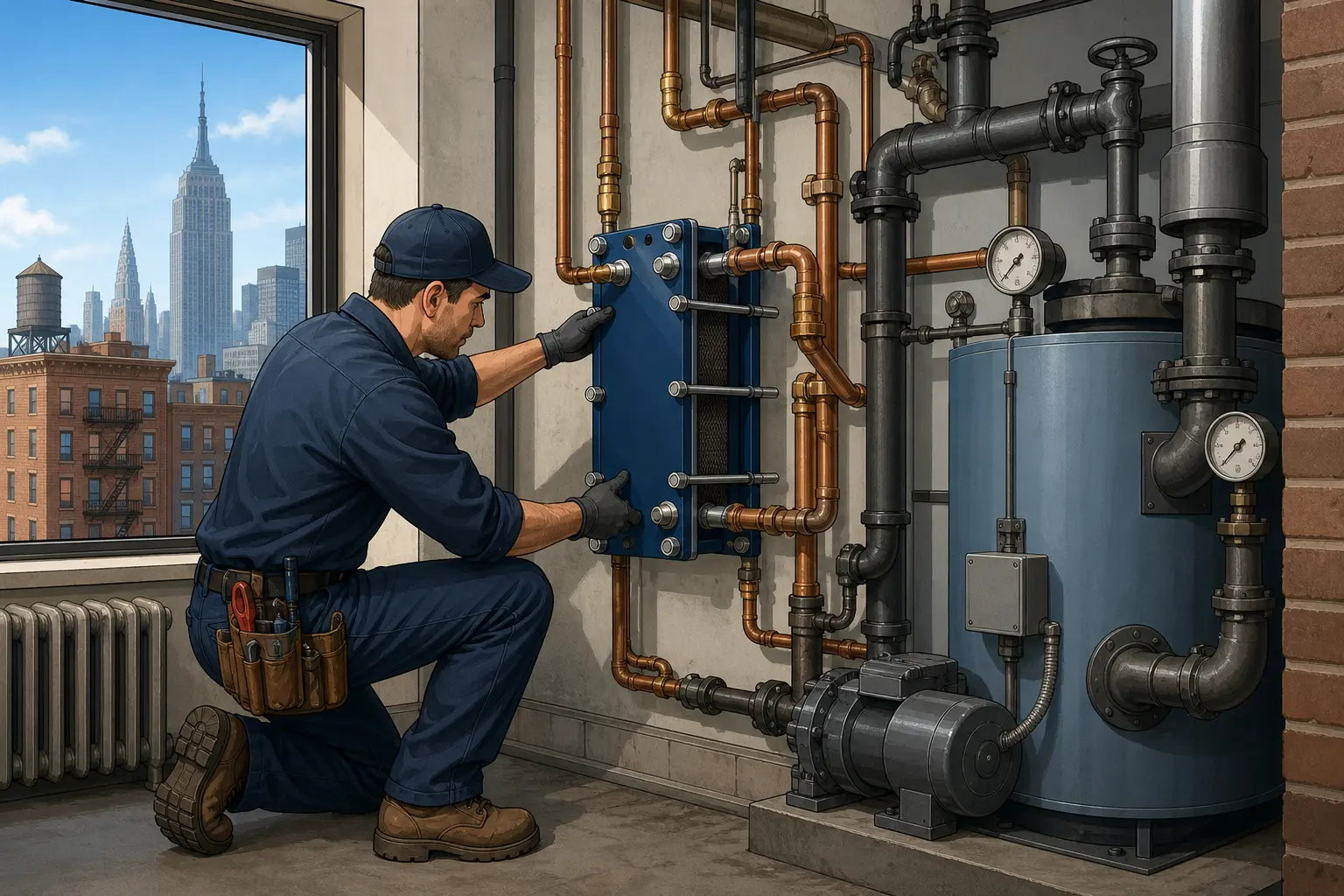
A straight comparison of steam heat exchangers and traditional boilers for NYC buildings, focused on how each one works with your existing steam risers and radiators.
Most NYC building owners replace a dying boiler with the same type of unit, just newer. It's the path of least resistance, and the old one did its job for 30 years, so why not. But that habit skips over a decision that can change your fuel bills and repair calls for the next few decades: whether a heat exchanger setup actually fits your building better than another traditional boiler.
Here's the part that trips people up. A steam heat exchanger and a traditional boiler are both trying to get heat and hot water to your tenants, but they get there in completely different ways once steam hits your existing risers and radiators. The real question is how each system behaves with the distribution piping already running through your walls and basement, much of which hasn't been touched since the building went up.
What Actually Separates These Two Systems
Here's where most of the confusion starts: a steam heat exchanger isn't a fancier boiler. It's a different job entirely. A boiler makes heat — it burns gas or oil and turns water into steam right there on site. A heat exchanger doesn't make anything. It takes steam that's already been produced somewhere else and transfers that heat into your building's system without mixing the two water supplies together.
That "somewhere else" matters, and it's the part a lot of owners skip over. In NYC, this conversation almost always traces back to Con Edison's district steam service, which runs under parts of Manhattan. If a building is on Con Ed steam, it's buying heat from the utility instead of generating it with its own boiler. A heat exchanger sits between that incoming utility steam and the building's own radiators and risers, converting the pressure and keeping the two water loops separate so contamination and pressure mismatches aren't an issue.
So the assumption that trips people up: swapping in a heat exchanger doesn't automatically mean the boiler goes away. Buildings not connected to district steam still need a boiler to generate heat in the first place — a heat exchanger has nothing to transfer if there's no outside steam source feeding it. It's really a question of where the heat originates:
- Boiler: generates steam on-site by burning fuel, serves the building directly
- Heat exchanger: receives steam from an external source (usually Con Ed) and transfers it into the building's loop
- Buildings off district steam almost always need a boiler regardless of other upgrades
- Older buildings with original steam risers often have infrastructure already suited to one approach over the other
- Pressure and water chemistry get isolated on each side of a heat exchanger, which boilers don't do
Knowing which category a building falls into is the first real decision point, and it's worth getting a straight read before pricing anything out through a service like high pressure steam heat exchanger and boiler services in NYC.
Where Each System Tends to Make Sense in NYC Buildings
The first question that actually narrows this down isn't cost. It's what's feeding the basement right now. A building already connected to Con Ed steam service is sitting on a natural case for a heat exchanger, because the steam is already arriving at the curb. The building isn't paying to generate it, just to move the heat from that steam into its own loop. Swapping in a gas-fired boiler at that point usually means fighting against infrastructure that's already paid for.
A building running its own gas-fired boiler, with a gas line sized for it and a flue already in place, usually stays in that lane when replacement time comes. Ripping that out to chase a heat exchanger setup means a Con Ed steam connection that may not exist on the block, or permitting and tie-in costs that erase whatever savings looked good on paper.
Pre-war co-ops tend to face this decision differently than a small multi-family owner doing a straight swap. A six-unit walk-up with an aging boiler usually just needs a reliable replacement sized to the existing radiators, done fast and done right. A larger pre-war co-op on Con Ed steam, weighing whether to install a heat exchanger instead of replacing a dying boiler outright, has board approval, capital planning, and a much longer system life to think about. The upfront analysis is worth more time there.
Mixed-use and commercial buildings add another wrinkle: domestic hot water demand. A ground-floor restaurant or a building with heavy commercial tenants pulls hot water in a pattern a straight residential building never sees, and that can push the equipment choice one way or the other depending on how the exchanger or boiler is paired with the DHW setup.
None of this makes one system universally better. It depends on what's already in the walls, the gas line capacity, the age of the risers, and whether steam service is even an option on that block. A licensed plumber who walks the basement and reviews the riser diagram can usually tell an owner which lane the building falls into, well before any like-for-like replacement gets assumed as the only option. Getting someone out to look at the specific setup beats guessing from a spec sheet.
Comparing Costs, Lifespan, and Maintenance Realistically
Installation price is the number everyone fixates on, and it's the least useful one for deciding anything. A heat exchanger swap can come in lower or higher than a comparable boiler replacement depending on the building's existing piping, how much the old equipment has to be gutted, and whether the room needs electrical or venting work to match code. Quoting that number alone and picking the cheaper bid is how buildings end up unhappy five years in.
What actually separates these systems financially is what happens after install. A boiler burns fuel on site, which means ongoing combustion-related service: burner checks, flue inspections, efficiency testing. A heat exchanger skips combustion entirely, so that whole category of upkeep disappears. But it's not maintenance-free. Plates and tubes scale up over time, especially given NYC's water hardness, and that scaling needs to get checked on a schedule or efficiency drops without anyone noticing until the heating bill shows it.
Staff familiarity matters more than most owners expect. A building's maintenance staff accustomed to boilers may need outside training, or a specialized vendor, to keep a heat exchanger running properly. That's not a dealbreaker, but it's a real cost to plan for, not an afterthought.
- Upfront cost: comparable range, varies more by site conditions than system type
- Lifespan: heat exchangers often outlast boilers since they're not exposed to combustion stress
- Routine maintenance: boilers need combustion-related service; exchangers need scale and inspection monitoring
- Staff readiness: boilers fit most existing building staff knowledge; exchangers may require training or a specialist vendor
None of that answers the question in isolation. Total cost of ownership, plus how a shutdown during a January cold snap affects tenants or a commercial lease, matters more than any single line item. That's a conversation worth having with a licensed contractor who can walk the mechanical room before quoting anything — not after. Buildwise's full range of plumbing and heating services covers both system types, which helps when a building isn't sure which direction it's leaning yet.
A Decision Framework for Choosing Between the Two
Here's how to actually work through this for a specific building, in order, before a contractor ever walks the basement.
Start with what's already there. Not what you wish was there, not what a neighboring building has — what's physically feeding your mechanical room right now. If the building already receives Con Ed steam service, a heat exchanger stays on the table in a way it simply can't for a building running on its own gas-fired boiler with no outside steam connection. That first fact rules out half the decision before cost or efficiency even enters the conversation.
From there, walk through the rest:
- What's the current fuel source and is outside steam service available at the building's location?
- How old is the building's piping and riser system, and has it been inspected or re-piped in the last 10-15 years?
- How many units or square feet does the system need to heat, and does occupancy swing seasonally (think mixed-use buildings or properties with vacant floors part of the year)?
- Does the mechanical room's current permitting and inspection history favor one system's installation timeline over the other?
- Is the mechanical room able to accommodate venting, electrical, or clearance changes if the equipment type changes?
Separately, any building with gas-fired equipment still has its own Local Law 152 gas piping inspection cycle to track, on whatever schedule applies to that property. That requirement runs independent of which heating system gets chosen here. It shouldn't factor into the heat exchanger versus boiler decision itself, but it's worth keeping on a separate calendar so it doesn't get confused with this one.
A 40-unit building with steady year-round occupancy answers these questions differently than a commercial property with two floors that go dark every summer. Heat demand that fluctuates hard tends to favor whichever system responds and modulates faster, and that's often the heat exchanger when outside steam is available — but not always, and not in every borough.
Pipe condition, existing code violations, and the building's actual heat loss numbers can shift the answer once someone's actually in the basement with a gauge. That's the piece a framework on a page can't substitute for.
Mistakes That Lead to Costly Reinstalls or Code Issues
Most of the expensive problems on this decision don't show up in year one. They show up in year three, when something fails and the building finds out the hard way what got skipped during installation.
The first mistake is picking whoever quoted the lowest number without confirming they're actually licensed for high-pressure steam work. Steam systems in NYC buildings run at pressures that standard residential plumbers and even a lot of general HVAC contractors aren't set up to handle. A master plumber license doesn't automatically cover it either — the question to ask directly is whether the installer has done high-pressure steam work specifically, not just hot water boilers or low-pressure systems in a two-family house. Get the wrong crew in there and you're looking at a redo, sometimes before the first winter is even over.
Second mistake: skipping a real load calculation and just matching the new unit's output to whatever the old one was rated for. Old equipment was often oversized to begin with, or the building's envelope has changed since it went in — new windows, added insulation, a floor that got converted from commercial to residential. Size the replacement off outdated assumptions and you end up with a system that either burns more gas than it should or can't keep the top floors warm on the coldest nights.
Third, and this one gets missed constantly: not confirming how the choice interacts with DOB and FDNY filing requirements before work starts. Steam systems have their own permitting path separate from a standard boiler swap, and inspectors will flag a job that wasn't filed correctly even if the install itself is sound.
Last thing worth flagging: emergency repair response can differ between the two system types. Heat exchanger components and the technicians trained on them tend to be harder to source on short notice than standard boiler parts in most NYC neighborhoods, so it's worth asking a contractor directly what a middle-of-the-night failure response looks like for whichever system a building picks, before that failure happens, not during it.
Getting a Straight Answer for Your Building
A blog post can't see what's actually in your mechanical room. Piping age, riser condition, what's feeding the basement, how the building's been patched together over forty years of prior work — someone has to stand down there and look. Anyone who says the decision can be made over the phone is guessing.
Before signing off on either option, there are a few questions worth asking whoever's bidding the job:
- Are they licensed specifically for high-pressure steam work, not just general plumbing or low-pressure hot water systems?
- Have they worked on buildings fed by the same steam source as yours, whether that's Con Ed or an on-site boiler plant?
- Who's pulling the permits, and are they handling the DOB and FDNY sign-offs directly, or passing that off to someone else?
- What happens if the inspection turns up something the original quote didn't account for?
A contractor who answers those cleanly, without hedging, is usually someone who's done this enough times to know where the problems actually hide. If the answers are vague, that's worth noticing before any contract gets signed, not after.
The reasonable next step isn't a commitment to replace anything. It's an on-site evaluation — someone looking at the actual piping, the actual steam source, the actual condition of what's down there now, and giving a recommendation specific to that building. Getting this wrong costs a lot more to undo than the evaluation costs to schedule. Buildwise Plumbing Heating & Contracting handles exactly this kind of assessment for high pressure steam heat exchanger and boiler work across NYC properties, and a conversation about what's feeding your building is a reasonable place to start.
Frequently asked questions
Is a boiler a heat exchanger?
No, and this is where most confusion starts. A boiler generates steam on-site by burning gas or oil. A heat exchanger doesn't generate anything, it takes steam that's already been produced somewhere else, usually Con Edison's district system, and transfers that heat into the building's loop without mixing the two water supplies. Buildings off district steam still need a boiler no matter what.
What are the different types of steam boilers?
Most NYC buildings run gas-fired or oil-fired steam boilers sized to the existing risers and radiators. The split that actually matters for a replacement decision isn't fuel type though, it's whether the building generates its own steam with a boiler or receives steam from an outside source through a heat exchanger. A licensed plumber walking the basement and checking the riser diagram can tell you which setup you're actually working with.
What is the difference between a steam boiler and a hot water boiler?
A steam boiler heats water past the boiling point and sends actual steam through risers to radiators, which is the standard setup in older NYC buildings with cast iron radiators. A hot water boiler circulates heated water through pipes without converting it to steam. Most pre-war buildings in NYC are built around steam distribution, so this decision usually isn't on the table during a like-for-like replacement.
What does a boiler look like?
It's a large metal unit, usually in the basement or a dedicated mechanical room, connected to a gas line or oil feed, a flue for venting combustion gases, and the piping that feeds your risers. A heat exchanger looks different since there's no burner or flue involved. It's a more compact unit built around plate or shell assemblies that transfer heat between two separate water loops without any combustion equipment attached.
How do I know if my building is even eligible for a heat exchanger instead of a boiler?
Check what's feeding your basement right now. If you're already connected to Con Ed district steam, a heat exchanger has something to work with. If you're running your own gas-fired boiler with a dedicated gas line and flue, you'd need a steam connection that may not exist on your block, plus tie-in and permitting costs that often erase any savings. Get someone to look at your specific setup before pricing anything out.