
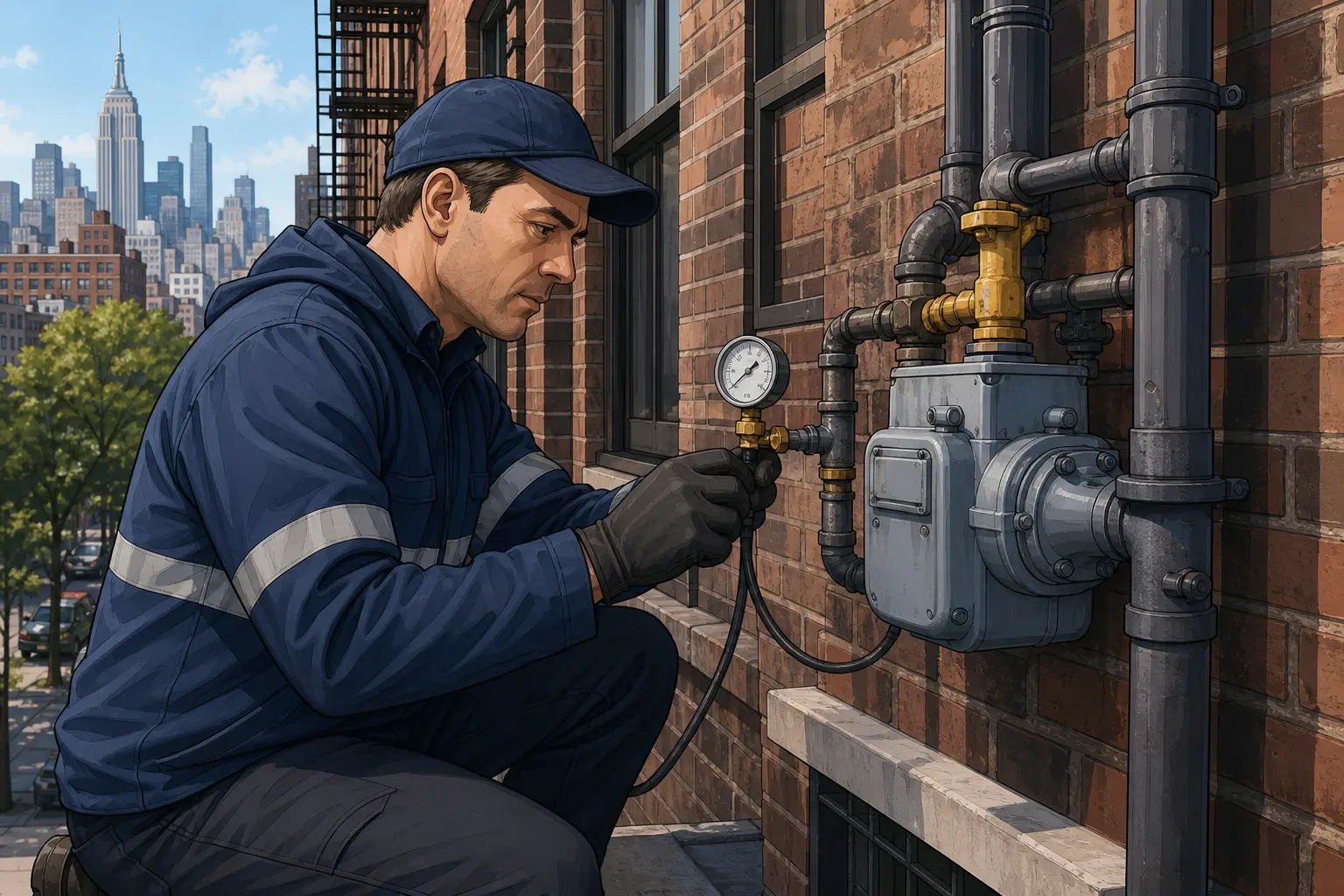
A gas line inspection isn't someone walking your basement with a clipboard for fifteen minutes. It involves real pressure testing, a check of your building's piping age and permit history, and specific steps that separate a compliant job from a rushed one. Knowing the sequence helps you tell whether the plumber who just left actually did the work.
Somebody catches a faint gas smell near the stove, or a co-op board gets a letter from Con Edison about a required inspection, and the question is always the same: is this actually necessary, and what's someone going to do to my building? A gas line inspection isn't a guy walking around sniffing the air near your meter. It's a specific sequence of checks, most of them documented, some requiring tools most owners have never seen used.
Knowing what that sequence looks like matters for one reason. It's the only way to tell whether the plumber who just left your basement did a real inspection or a fifteen-minute walkthrough with a clipboard. Property managers who've been through a few of these notice the difference fast, especially when a report comes back thin on detail or skips steps a compliant job should include.
Why NYC Properties Need These Inspections at All
Some inspections happen because a rule says they have to. Others happen because somebody got nervous. Both are legitimate reasons to call a plumber out, but they're different situations, and it helps to know which one applies before the appointment even gets scheduled.
On the compliance side, a lot of NYC buildings deal with inspection requirements tied to Con Edison and the Department of Buildings that don't really have an equivalent in other cities. Selling a property, installing a new gas appliance, or falling under a local law compliance cycle can all trigger a required inspection, even with no leak or complaint in sight. Exactly which local law applies depends on the building type and the work being done, so it's worth confirming with a licensed plumber or the DOB rather than assuming. A co-op board might order one because the buyer's attorney wants documentation before closing. A commercial landlord might need one because insurance renewal depends on it, or because a new tenant's lease requires proof the system checks out. None of that has anything to do with a suspected problem.
The urgent version is a different animal: somebody smells gas, there was construction or excavation nearby that might have disturbed a line, or the piping is old enough that nobody's confident in it anymore. That kind of inspection gets scheduled same-day, not penciled into a compliance calendar.
No smell doesn't mean no problem, and this trips people up constantly. Corrosion, a loosening fitting, or a joint that's slowly failing can sit there for a while before anyone notices an odor. By the time it's obvious, it's usually further along than anyone would like.
Typical triggers worth knowing:
- Sale or refinance of the property, requested by a buyer's attorney or lender
- New appliance installation requiring sign-off on the connected line
- Local law compliance cycles administered through the DOB
- Suspected leak or a lingering, unexplained gas odor
- Nearby excavation, construction, or utility work that could have shifted piping
- Co-op or condo board requirements tied to insurance renewal or tenant turnover
Anyone unsure which category they fall into can look at what a full gas line inspection and repair visit actually involves before deciding whether it's a routine call or one that needs to happen today.
The Visual and Documentation Check Before Any Tools Come Out
Before a plumber even touches a fitting, a good chunk of the inspection has already happened with a clipboard, or more likely a tablet these days, and a look around. Building age comes first. A pre-war building in Brooklyn with original galvanized pipe gets treated very differently than a 2015 build with black iron throughout. Older galvanized piping corrodes from the inside, which doesn't always show on the surface, so knowing the era of the piping tells the inspector what to expect before the leak detector even comes out of the bag.
Prior permit history matters too. If there's no record of a permit for work that clearly happened — a stove that got moved to the other side of the kitchen, say — that's a flag before anything gets tested. This is also where an inspector catches things a homeowner or building super might not even know are a problem: corrosion at joints, flex connectors running longer than they're rated for, vents without proper clearance from windows or air intakes, DIY connections someone made without a permit. Those add-a-line jobs from a handyman a few years back show up more often than people expect.
A fifteen-minute walk-through with a sniff test doesn't count as a real inspection. If the technician skips reviewing piping material and past permits, that's a corner being cut, not a shortcut that saves time. In multi-unit buildings this step gets more complicated too, since shared risers often mean getting access to neighboring units, and that alone can turn a same-day visit into something scheduled a week out.
How the Actual Pressure and Leak Testing Works
Once the visual pass is done and the paperwork checks out, this is the part that actually tells you whether the pipe is holding gas the way it should. The plumber isolates the section of line being tested, pumps it up with air or inert gas to a set test pressure, then watches the gauge. Pressure holds steady over the monitoring period, the line's tight. It drops, there's a leak somewhere in that run, and the next step is finding exactly where.
Finding it usually means an electronic leak detector run along every joint, fitting, and union, sometimes backed up by an old-fashioned soap-and-water solution brushed on those same spots. Bubbles forming means gas is escaping right there. Low-tech, but reliable, and most plumbers use both tools together rather than trusting one over the other.
Here's the part that catches building owners off guard: gas has to be shut off to the whole line during testing. No pilot lights running, no appliances pulling gas, nothing live while that pressure test is underway. For a single-family brownstone that might mean the stove and water heater are down for an hour or two. For a commercial kitchen or a multi-unit building, it means real coordination — tenant notices, a heads-up to the restaurant downstairs, maybe scheduling around business hours. Worth asking about upfront when booking.
The monitoring period is where corners get cut, and it's a mistake that costs people later. A slow, gradual leak doesn't always show up in the first few minutes of a test — pressure can bleed off slowly instead of dropping fast, which is exactly why the hold time matters as much as the pass/fail result. There's no single industry number every plumber uses for how long that hold should last; it depends on the line, the test method, and the technician's judgment. Anyone reviewing an inspection report should still ask how long the line was actually held under pressure, not just whether it passed, since a rushed test can miss a slow leak that a longer one would catch. For buildings dealing with permit questions tied to this kind of work, it's worth reading up on when gas line work requires a permit in NYC before assuming a passed test is the end of the paperwork.
A Simple Walkthrough of What Happens Start to Finish
Most property owners just want to know how long they need to block off on their calendar and what they should have ready. Here's roughly how the appointment moves for a typical residential unit or small commercial space.
- Scheduling and access coordination — someone confirms the appointment window and, for multi-unit buildings, arranges access to individual apartments or units that share the gas line being tested.
- Gas shutoff at the meter or at isolation valves, so the line can be depressurized safely before anyone starts opening fittings.
- The visual and paperwork review covered earlier — pipe material, age, prior permits, any visible corrosion or unsupported runs.
- Pressure testing the isolated section and watching the gauge over the hold time the technician determines is appropriate for that line.
- Checking appliance connections — stoves, water heaters, boilers, dryers — making sure shutoff valves work and connectors aren't old flex line that should've been swapped out years ago.
- Documentation and the report, either handed over on site or sent shortly after, noting what passed, what didn't, and what needs follow-up.
For a single apartment with straightforward access, this whole thing might run an hour or two. A brownstone with three units and old branch lines feeding each floor takes longer. Commercial spaces are their own animal — a restaurant kitchen or a laundromat can't just go dark mid-afternoon, so a lot of that work gets scheduled after close or before opening, even if it costs a bit more to bring a tech out at those hours.
Before the technician shows up, clear a path to the meter and to every gas appliance in the unit. Dig up any old permits or prior inspection reports if they exist — it saves time and helps the plumber understand what's already been done versus what's original to the building. Buildings with multiple gas customers or complex risers sometimes benefit from a broader look at the whole system rather than a single-unit check.
Red Flags in an Inspection Report You Shouldn't Ignore
The report itself is usually a page or two, sometimes with photos, and the findings section is where property owners tend to either relax too much or panic more than they need to. Neither reaction helps. What matters is knowing which line items mean "stop using this appliance today" and which mean "get this on the schedule for next month."
A few findings show up often enough to be worth knowing before you're staring at one:
- Corroded or heavily rusted fittings — common in older galvanized systems, and depending on severity this can go either way, sometimes urgent, sometimes something to monitor for a few months
- Undersized gas lines for the appliance load — usually not an emergency, but it needs correcting before a new range or boiler gets connected, not after
- Missing or inaccessible shutoff valves — this one tends to get flagged for prompt correction, because in an actual leak or fire scenario, not being able to kill the gas fast is a real problem
- Unpermitted work from a previous owner or tenant — sometimes fine physically, sometimes a mess, but it always needs documentation and often re-inspection before a co-op board or DOB will sign off on anything else in the unit
The dividing line between fixing something now and planning for it later usually comes down to whether the finding involves active leakage, a failed pressure test, or a safety device that isn't working at all. Active gas leakage or an outright failed pressure test almost always means shutting that line down right away, though the exact response can depend on where the leak is and how the building is set up. Corrosion that hasn't compromised the pipe wall yet, or a line that's undersized but functioning safely at current load, usually gets a scheduled repair window instead.
A report can sit in an inbox for three weeks because nothing smelled like gas and the stove still lights fine. Some of these findings don't announce themselves with a smell. A slow pressure loss or a corroded fitting can sit there quietly until it isn't quiet anymore.
In a multi-tenant building this gets more complicated, because one unit's bad fitting or corroded branch line can sit on the same riser feeding four or five other apartments. What looks like a single-unit issue on paper can change the urgency for the whole building, which is part of why building management usually wants to see the report, not just the tenant.
Getting the Inspection Done Right the First Time
Price shouldn't be the deciding factor here. Gas work carries real liability, and a cheaper inspection that misses a corroded fitting or skips proper pressure testing doesn't save money — it just moves the cost down the road to a repair bill or, worse, an incident. Anyone comparing quotes on a gas line inspection should weigh qualifications first and price second.
Before booking, a few questions are worth asking directly:
- Is the technician licensed to do gas work in New York City, and can they show proof?
- Will there be a written report with findings, not just a verbal rundown at the door?
- If something needs repair, does the same company handle that, or does the property owner have to find and vet a second contractor?
That last question matters more than it seems. An inspection that turns up a leaking union or a section of undersized pipe is only half the job. If the plumber can't also do the repair, the property owner is stuck scheduling a second visit, sometimes with a different company that has to re-review everything the first one already found. That's lost time on something that, in a lot of cases, could've been fixed the same day or within the week.
A co-op board dealing with a Con Edison notice, or a homeowner who caught a whiff of gas near the stove, doesn't need to wait for the problem to get worse before making a call. Buildwise Plumbing Heating & Contracting handles the inspection and the repair work under one license, one visit plan, and one point of contact. Anyone looking into gas line installation and repair in NYC can get both the inspection and whatever fix follows scheduled without starting over with someone new.
Frequently asked questions
How long does a gas line inspection take?
For a single unit with straightforward access, figure somewhere in the range of an hour to a couple hours, once the plumber gets through the visual check, permit history review, and pressure test. Multi-unit buildings take longer, especially if the line runs through shared risers and the tech needs access to neighboring apartments to isolate the section being tested. That scheduling alone can push a same-day visit into something booked a week out.
What does a gas line inspection consist of?
It starts before any tool comes out: the plumber looks at piping material, building age, and whether permit history matches what's actually installed. Then comes the pressure test, where the line gets isolated and pumped with air or inert gas to see if it holds steady. If pressure drops, an electronic leak detector and a soap-and-water check pinpoint exactly where gas is escaping.
How often do gas lines need to be inspected?
There's no single citywide interval that applies to every building. Some inspections are triggered by a sale, refinance, or new appliance installation. Others come out of a local law compliance cycle tied to the building type, or get requested by a co-op board renewing insurance. Buildings with older galvanized piping are worth checking more often than newer construction with black iron, since corrosion there doesn't always show on the surface.
How long does it take to get sick from natural gas exposure?
This isn't something the article covers directly, and it depends heavily on concentration and ventilation, so it's not something to guess at. What matters more for prevention is catching problems before exposure happens at all. Corrosion, a loosening fitting, or a slowly failing joint can sit for a while with no noticeable odor, which is exactly why a real inspection checks piping condition and connections, not just whether anyone smells gas that day.
Why does the gas need to be shut off during testing?
Pressure testing only works if the whole line is isolated, which means no pilot lights running and no appliances pulling gas anywhere on that line while the test is underway. For a single-family brownstone that might just mean the stove and water heater go dark for a bit. In a building with shared risers, it can mean coordinating a shutoff across multiple units, which is part of why these inspections take real planning instead of a walk-in visit.